Why You Lose Money Before the Flop: 5 Preflop Mistakes Beginners Make
If you’ve just started playing poker or haven’t gone too deep into it yet, you might have noticed something strange: it feels like you understand everything, play carefully — but the money still slips away. Sometimes very quickly.
Often, the problem isn’t what happens on the flop or river. It starts much earlier — before any community cards hit the table. Right on the preflop.
In this article, we’ll break down five of the most common preflop mistakes — in simple terms, without unnecessary complexity. And we’ll show how the FreeBetRange tool helps fix them.
What is preflop and why it matters
If you’re not entirely sure: preflop is the first betting round in poker. The dealer gives everyone two cards, and now each player decides: enter the pot or not. And if yes — how.
This is the most important moment in the hand. Why? Because this is where you decide which hands and in what situations you’ll continue playing. If you start off in a bad spot, fixing it on the flop, turn, and river becomes much harder — and more expensive.
Let’s jump straight into the mistakes.
Mistake #1. Limping
What is a limp
A “limp” is when you just call the minimum bet (1 big blind) instead of raising. It looks like this: no one has raised before you, and you simply say “call 1bb.”
Many beginners do this — it feels safe: you enter cheaply, see the flop, and if things go wrong, you only lose a little.
What’s the problem
There are several issues:
You can’t win the pot right away. If you raised, some opponents might fold and give you the money already in the pot. With a limp, you don’t have that chance.
Players behind you can attack. An experienced player in the next position sees your limp and makes a big raise. Now you either fold and lose your blind, or continue in a bad situation.
Others enter cheaply too. The blinds are happy to continue for almost nothing. As a result, you see the flop against three or four opponents instead of one — this is called a multiway pot, and it’s much harder to win.
You lose initiative. The player who raises controls the action on later streets. The limper just reacts.
A simple rule
If your hand is good enough to enter the pot — raise. If not — fold. Limping is usually the worst of the three options.
How this looks in FreeBetRange
FreeBetRange is a tool for studying poker ranges (the sets of hands you should play in different situations). It already includes ready-made “correct” ranges.
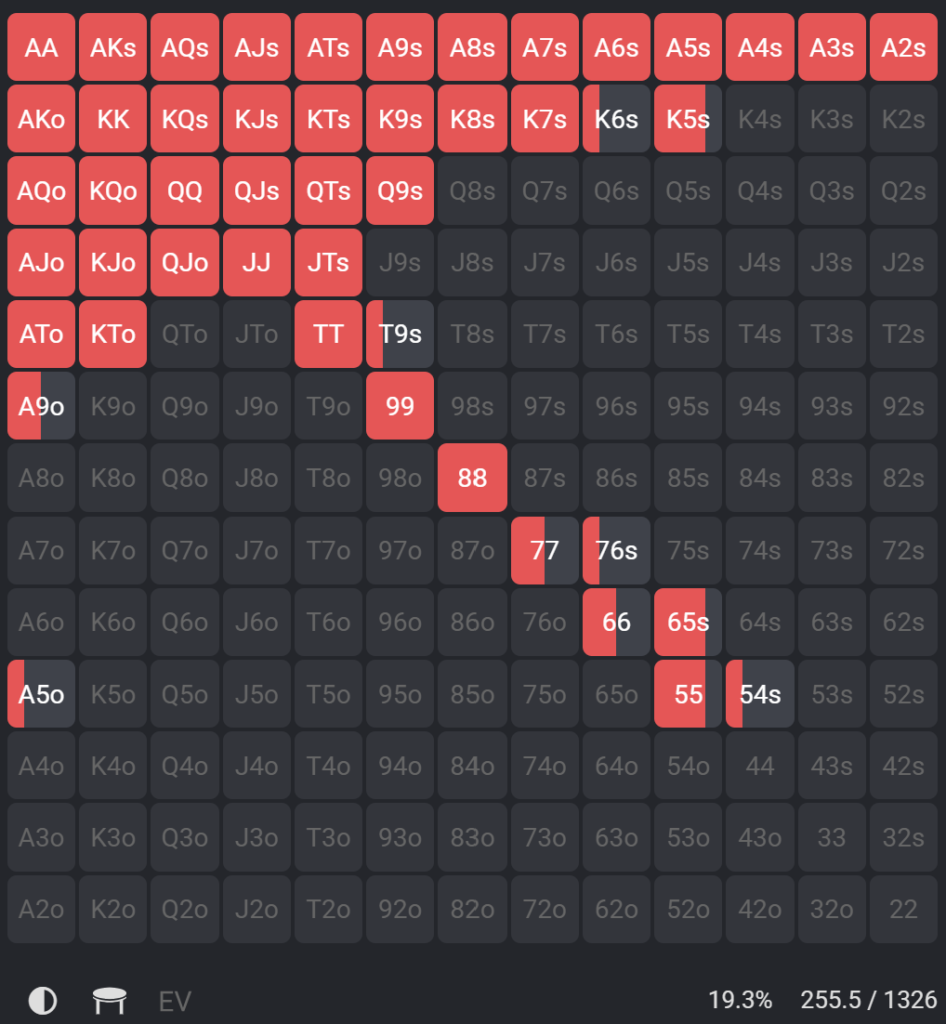
Go to the Viewer section and open any range. You’ll see a colored table of 169 possible hand combinations. Red means raise. Gray means fold. You’ll barely see any yellow (limps). That’s because in a solid strategy, limping is almost never used.
Mistake #2. Playing the same hands the same way from every position
What is position?
There are different positions at the poker table. Some are better, others worse. The most profitable seat is the button (BTN). The player on the button acts last on the flop, turn, and river. That’s a huge advantage: you see what everyone else does before making your decision.
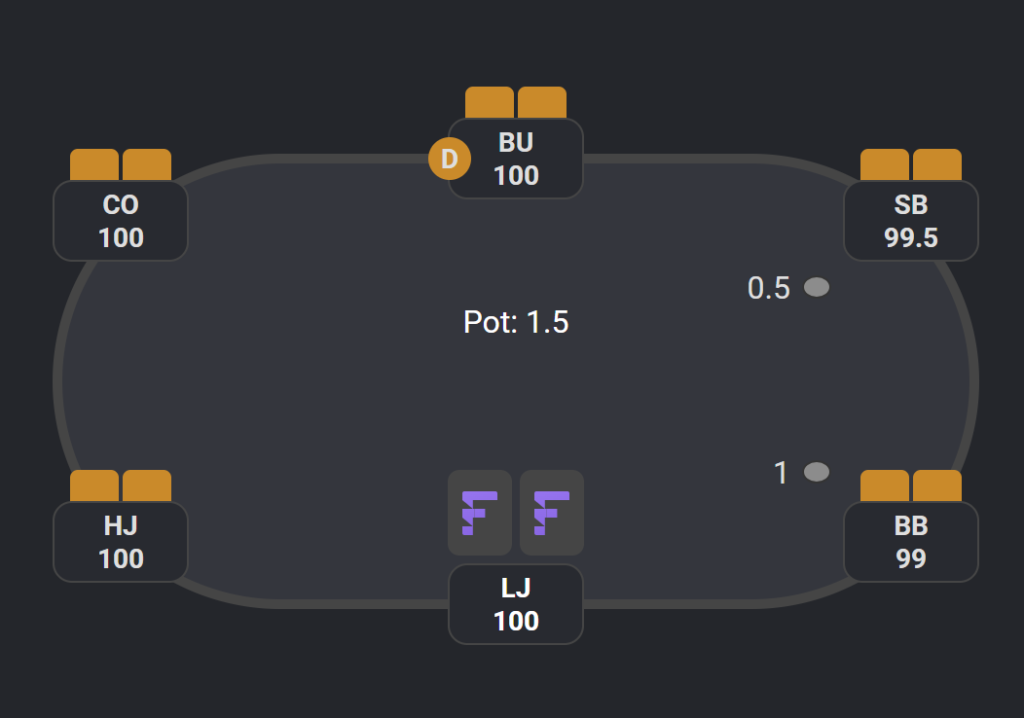
The worst positions are the early ones (UTG or LJ), where you act first.
What’s the mistake
Many beginners think: “I have J9s — that’s a decent hand, I’ll play it.” And they play it from any position.
But J9s from UTG and J9s from the button are two very different situations. From the button — it’s a great hand to open. From UTG — it’s questionable, because there are still six players behind you, and someone could easily have AK, QQ, or KK.
Simple rule: the better your position (the later you act, up to and including the BTN), the more hands you can open. From early positions — only the strongest hands. From the button — you can open very wide.
A clear example
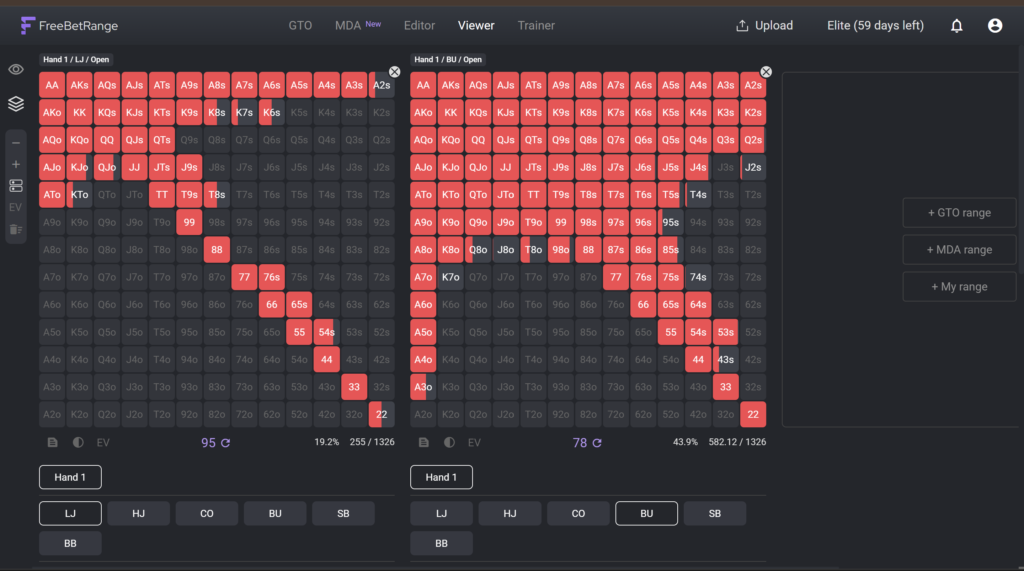
From the button (when everyone folds to you), you can open around 40–45% of all possible hands. From UTG — only about 15%.
If you ignore position, you will either:
- Lose too much by playing weak hands from early positions,
- Or miss value by folding decent hands on the button.
How FreeBetRange helps you understand this
In FreeBetRange, there’s a great Multi-range mode in the Viewer. You can open multiple ranges side by side — for example, UTG and button — and immediately see the difference.
Mistake #3. Raising too small or too big
Why sizing matters
When you raise preflop, it’s not just about raising, but also about how much you raise.
Imagine raising to just 2 big blinds. The player in the big blind only needs to call 1 more blind to see the flop. That’s very cheap — and they’ll continue with almost any hand. As a result, you’ll face a wide opponent range on the flop, which is uncomfortable.
But if you raise too large (for example, 8–10bb), you risk a lot, and your opponents will just fold almost everything — you win a small pot and nothing more.
Good starting sizes
Solid baseline sizes for online cash games:
- From early positions: raise to 2.5–3 big blinds.
- From late positions (button): raise to 2–2.5 big blinds.
Another key point: use the same sizing regardless of your hand. If you raise AK to 3bb but K9 to 2bb, observant opponents will notice and figure out when you’re strong. We also recommend checking our guide on preflop sizing.
About 3-bets
A “3-bet” is when someone has already raised and you raise again. If you 3-bet, your size should usually be about 3x the original raise (when in position) or 3.5–4x (when out of position).
Mistake #4. No clear plan for which hands to play
What’s the problem
Beginners often decide on the fly: “This hand looks okay — I’ll play,” or “Not sure — I’ll fold.” There’s no clear structure.
This causes two problems:
- You become inconsistent, which makes you predictable or unpredictably bad.
- You’re easily influenced by impulses: “I’m bored,” “I feel like playing,” “maybe I’ll get lucky.”
The solution — opening ranges
A range is simply a table of which hands to open from each position. It looks like a colored 13×13 matrix. You study it, memorize it — and at the table, you already have the answer.
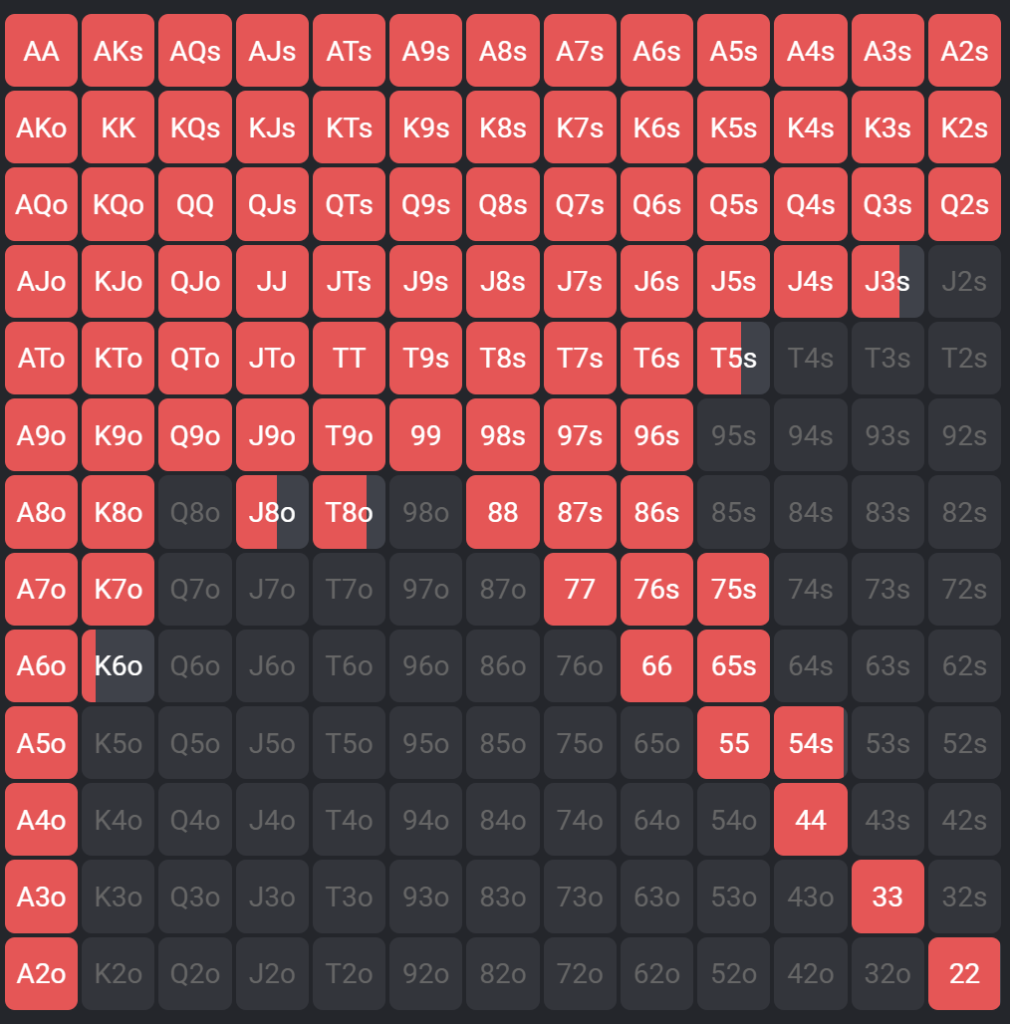
This is exactly what FreeBetRange is built for.
How to use FreeBetRange as a beginner
- Sign up at freebetrange.com (it’s free).
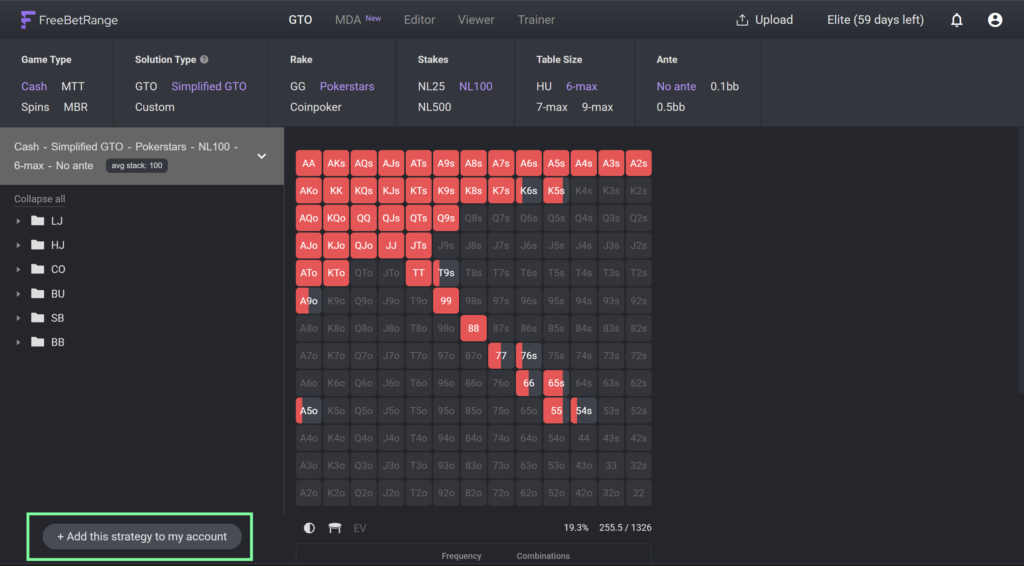
- Go to the GTO Library and add ready-made ranges for your format — there are solutions for cash, tournaments, and Spin&Go.
- Open the Viewer and study ranges position by position. Try to understand the logic: why A5s is played from the button but not from UTG.
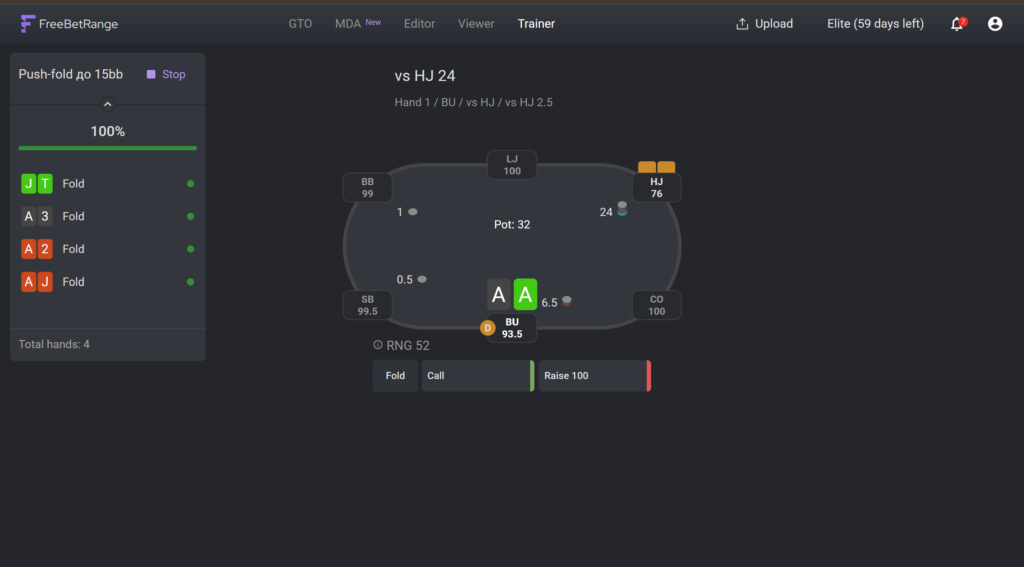
- Go to the Trainer → “Classic” mode. You’ll be dealt hands and asked: “What do you do?” You answer, and the program tells you if you’re right. This is the fastest way to memorize ranges.
Mistake #5. Panicking when facing a 3-bet
What happens
You open with a decent hand. Your opponent raises again — a 3-bet. And you… panic. Either you fold everything (“better not risk it”), or stubbornly call even weak hands (“I can’t just give it up”).
Both are mistakes.
What “3-bet panic” looks like
Folding too much: if you fold to every 3-bet, opponents will quickly notice and start 3-betting you relentlessly. They don’t even need strong hands — they just need to know you’ll give up.
Calling too much: if you call 3-bets with hands like J9s or 66 from early position, without position and with mediocre strength, you’ll often lose money even when you hit a pair on the flop.
Simple rules to start
- Against a 3-bet with strong hands (AA, KK, QQ, AKs) — prefer a 4-bet over calling.
- Against a 3-bet with medium-strength hands (JJ, TT, AQo) — it depends on position and opponent.
- Against a 3-bet with weak hands — usually fold, especially from early positions.
How FreeBetRange helps here
The FreeBetRange Library includes not only opening ranges but also defense ranges vs 3-bets. Open the Viewer and find the “Defend vs 3Bet” folder — it shows what to 4-bet, call, or fold for each position.
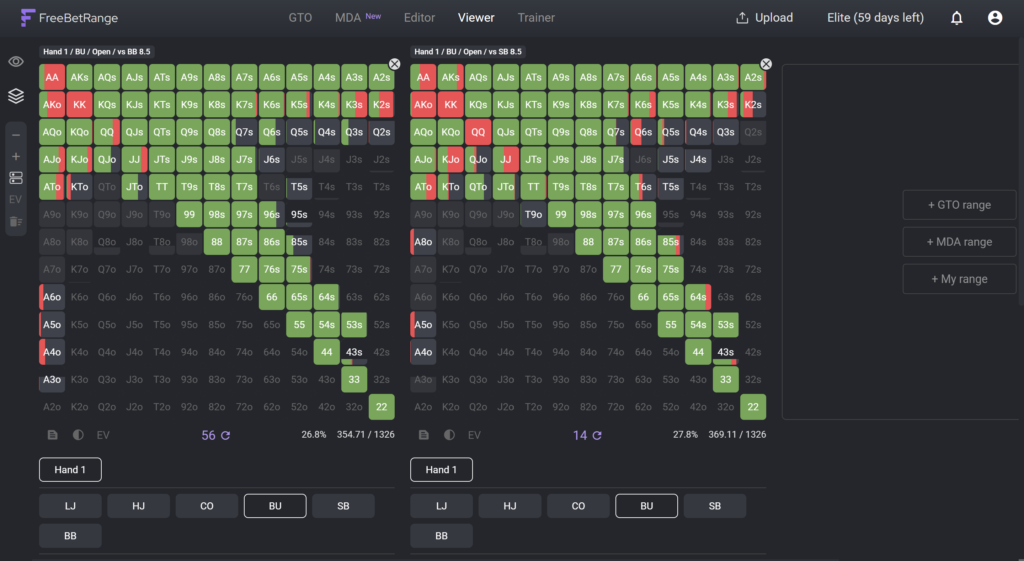
Launch the Trainer with these ranges and practice responding to 3-bets — slowly at first, then faster, until your reactions become automatic.
Summary: where to start right now
If you want to stop losing money before the flop, here are three simple steps:
Step 1. Remember: limping is for rare exceptions — usually it’s raise or fold.
Step 2. Understand that position matters a lot: play wider on the button, tighter in early positions.
Step 3. Study ranges — clear tables showing what to do with each hand. FreeBetRange helps you memorize them through practice in the Trainer.
Even 15–20 minutes of daily training in FreeBetRange can quickly change how you approach preflop and make every session calmer and more profitable.
Master GTO preflop strategy, build your own ranges, and train smarter — all in one powerful tool.
Try FreeBetRange