What Is Preflop in Poker: Explained from Scratch
Poker isn’t just about cards and luck. It’s a game of decisions. And the very first decision in every hand happens before a single community card hits the table. This stage is called preflop—and it largely determines whether you win the hand or lose money. If you’re just getting into poker or finally want to understand what this term means, read on.
Let’s start from the very beginning: how a hand works
If you’re new to poker, let’s start from scratch.
Each hand in Texas Hold’em is like a mini story with several chapters. These chapters are called streets or betting rounds:
- Preflop — the beginning. Cards have just been dealt, and there are no community cards yet.
- Flop — three community cards are revealed on the table.
- Turn — the fourth community card.
- River — the fifth and final community card.
At each stage, players place bets and make decisions. The winner takes the entire pot.
Today we’re focusing on the very beginning—preflop. Everything starts here.
What is preflop — the simplest explanation
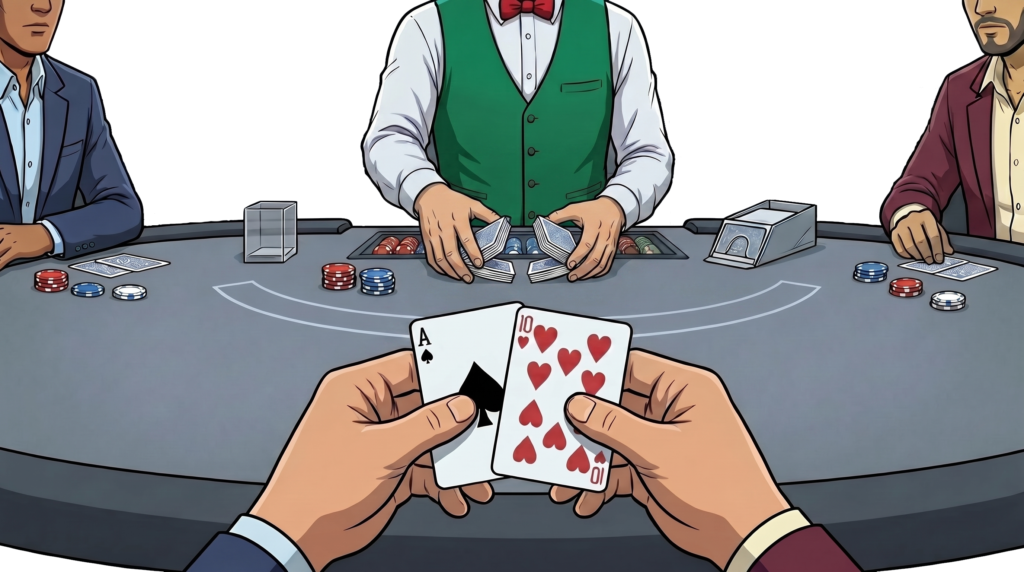
Preflop is the moment in poker when each player has just received their cards, but no community cards have been dealt yet.
Each player looks at their two cards and thinks: “Should I play this hand?”
A simple analogy: Imagine you’re buying a lottery ticket. But instead of a random pick, you already know two out of six numbers. Do you buy the ticket or not? That’s your “preflop.”
The stronger your two cards and the better your position at the table, the more profitable it is to play. The weaker they are, the more разумно it is to fold right away.
Mandatory bets: why blinds exist
Before the cards are dealt, two players are required to put money into the pot. These forced bets are called blinds.
- Small blind (SB) — the first player to the left of the dealer posts a small amount.
- Big blind (BB) — the second player posts twice as much.
Why is this necessary? Without blinds, no one would risk chips without premium hands—everyone would just wait for pocket aces. Blinds create an initial pot and make the game dynamic: now there’s something to fight for right away.
Important: Blinds are mandatory. They are not “bets with a strong hand”—they are posted regardless of your cards. That’s why players in the blinds are in a unique situation: they’ve already invested money, but their cards can be anything.
What happens preflop step by step
Let’s walk through the process step by step:
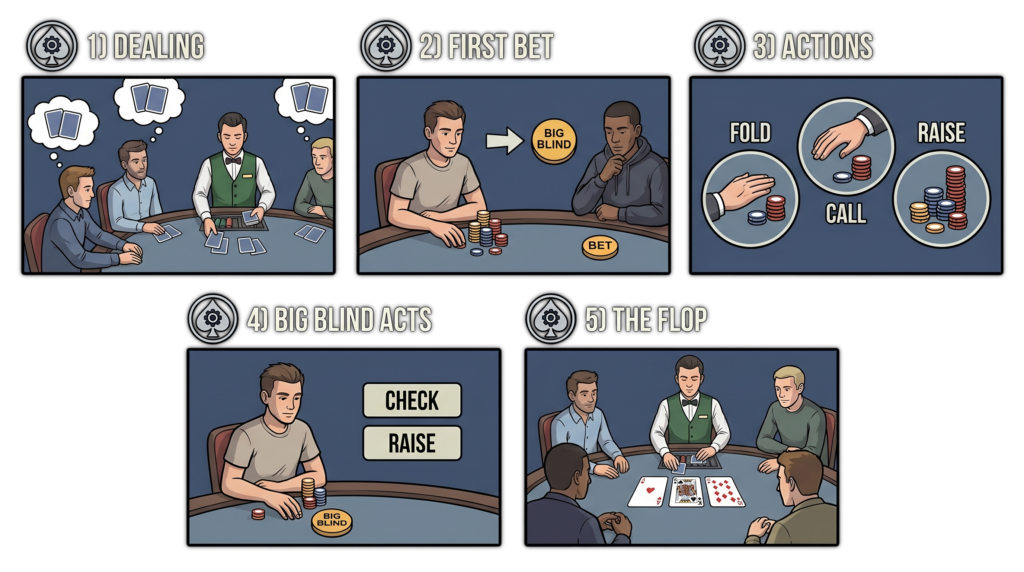
Step 1. The dealer gives each player two face-down cards. No one else can see your cards.
Step 2. The betting begins. The first to act is the player immediately after the big blind.
Step 3. Each player, in clockwise order, decides whether to fold, call, or raise.
Step 4. The big blind acts last. If no one has raised, they can either check (continue for free) or raise.
Step 5. Once all decisions are made and bets are matched, the preflop stage ends. The dealer reveals three community cards (the flop), and the game moves on.
What decisions each player makes
Preflop, each player has several options:
Fold — you give up your cards and exit the hand. You don’t invest anything more. This is normal and correct—professionals fold most hands preflop.
Call — you match the current bet to stay in the hand.
Raise — you increase the bet. This shows strength or puts pressure on opponents.
All-in — you bet all your chips. Usually done with very strong hands or a short stack.
Example:
- Someone raises first to 3bb (3 big blinds) — this is called an open raise
- You raise to 9bb — this is called a 3-bet
- Someone raises again to 24bb — this is a 4-bet
Why you shouldn’t play every hand
One of the biggest temptations for beginners is to “see the flop” with any two cards. What if you get lucky?
The problem is that “getting lucky” is not a strategy. In poker, the winners are those who make correct decisions over the long run, not those who got lucky once.
If you constantly enter pots with weak hands:
- You’ll often find yourself in situations where your hand is clearly weaker than your opponent’s
- You’ll feel lost on the flop and turn, not knowing what to do
- Your money will slowly but inevitably disappear
Strong starting hands lead to more frequent wins, easier decisions on later streets, and greater peace of mind—you’re not chasing luck, you’re playing correctly.
What position is and why it matters
Position is your seat at the poker table. It sounds simple, but it’s one of the most important factors in the game.
The key rule: The player who acts last gains information.
Why? Because you’ve already seen what everyone else has done before making your decision.
Example:
- You’re on the button (BTN) — the best position
- A player to your left raises, everyone else folds
- You see this and make your decision with full information about the table’s actions
Now imagine the opposite:
- You’re in early position (UTG)
- You have to act first
- You don’t yet know what 5–8 players behind you will do
That’s why you play fewer hands from early positions and more from late positions. It’s not a preference—it’s math.
The main positions at a 6-max table look like this:
| Position | When it acts | Why it matters |
|---|---|---|
| UTG (LJ) | First | The worst position — everyone is still to act |
| HJ (MP) | 2nd | Still early, requires caution |
| CO (Cutoff) | 3rd | Good position |
| BTN (Button) | 4th | Best: acts last on flop, turn, and river |
| SB (Small Blind) | 5th | Acts first on all streets except preflop |
| BB (Big Blind) | Last | Closes the preflop, but is out of position afterward |
How hand ranges work — a simple explanation
Experienced players don’t think “I have J9, should I play or not?” They think: “From this position, my range is this set of hands. Does J9 fit into it? Yes — I play it; no — I fold.”
This “set of hands” is called a range. And this way of thinking is called range-based thinking.
Why is this better than making isolated decisions?
First, you don’t have to rethink everything every time. You define a range once and apply it automatically. Second, you avoid emotional decisions: “but I have an ace!” — if a specific hand isn’t in your range for that position, it’s a fold, no exceptions. Third, you become harder to read: a range includes both strong and weaker hands, making it tougher for opponents to pinpoint what you have.
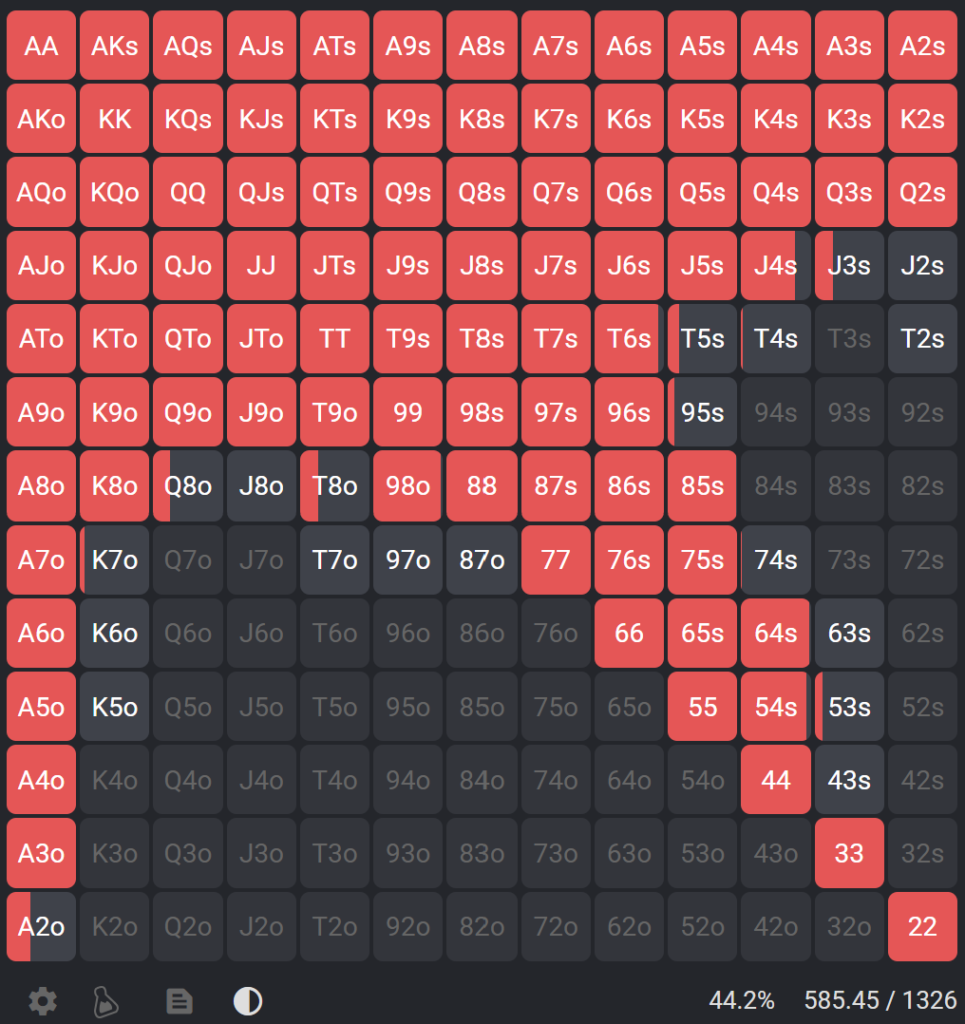
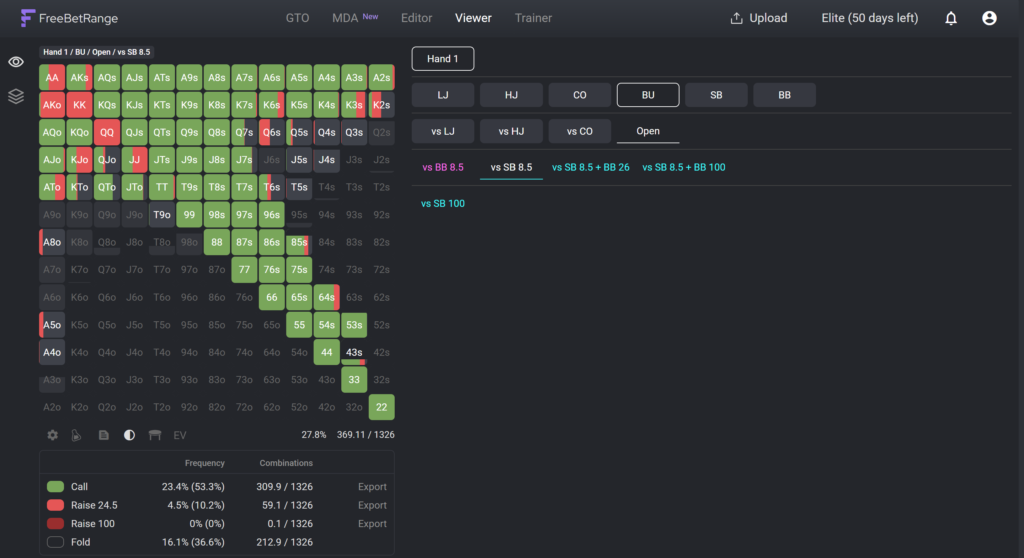
A range is typically shown as a 13×13 grid. The rows and columns represent card ranks from ace to deuce. Each cell is a two-card combination. Colored cells are hands you should play; uncolored ones are folds. This grid is called a 13×13 matrix or simply a range chart.
Rule for beginners: Find a solid range chart for your format and position—and stick to it. That alone will already put you ahead of most beginners.
Why solid preflop play is half the battle
Many beginners focus mostly on postflop play: “how to bet the flop correctly,” “what to do on the river with second pair.” But professionals know that for most players, fixing preflop mistakes brings the biggest improvement in results.
Here’s why.
Frequency of situations. Preflop happens in every hand. The flop, turn, and river only happen if you enter the pot. Fixing mistakes on the first street automatically improves everything that follows.
Simplicity. Postflop play requires reading the board, analyzing opponent ranges, and calculating pot odds. Preflop is based on clear rules you can learn in advance.
Mistakes carry forward. If you enter a pot with a weak hand in a bad position, you’ll face tough decisions on every street—and usually without a good answer. You’ll be “putting out fires” that you started preflop.
Consistency. Solid preflop play makes your overall game more consistent. And consistency is the enemy of mistakes.
FreeBetRange: ready-made tools for learning ranges
Once you understand that ranges matter, the next question is: where do you get good ranges?
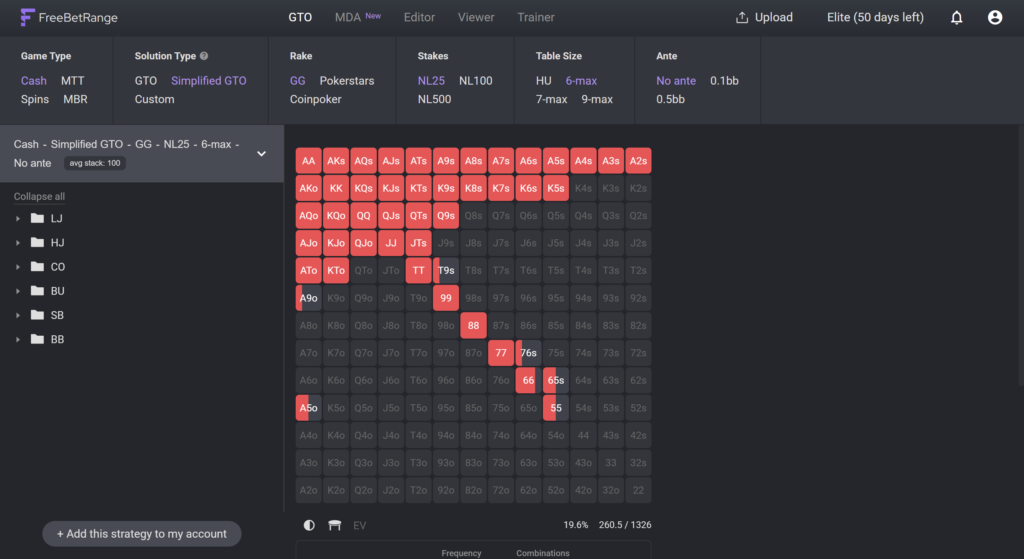
FreeBetRange is a dedicated tool that provides ready-made ranges for different poker formats.
What you’ll find there:
- Ranges for 6-max and 9-max cash games
- Ranges for tournaments and Spin&Go
- Breakdowns by position: UTG, HJ, CO, BTN, SB, BB
- A training mode where you can test how well you’ve learned the material
How to get started:
- Go to the Library section (range library)
- Select your game format
- Open the opening range for the desired position
- Study which hands to open and which to fold
- Practice in Trainer mode — the program will quiz you on specific hands
This is far more effective than just reading theory. Knowledge only turns into skill through practice.
Preflop is where everything begins. Get it right from the start, and poker will become both clearer and more profitable.
Master GTO preflop strategy, build your own ranges, and train smarter — all in one powerful tool.
Try FreeBetRange