How to Learn Poker Ranges from Scratch: A Simple Guide for Beginners
When you start playing poker, it feels like the most important things are understanding hand rankings, bluffing, and reading your opponents. Ranges, at this stage, seem like something for “serious” players — complex tables studied by those aiming to go pro.
In reality, ranges are the foundation. The sooner you learn them, the faster you’ll improve.
Players who know their ranges make correct preflop decisions automatically — without hesitation. This means fewer mistakes, fewer random “spews” into bad spots, and more confident postflop play — because you’re entering every hand with a plan, not just “let’s see what happens.”
Players without ranges often play too wide (“suited 7-6, why not?”) or too tight (“better fold, just in case”). In both cases — it’s money lost.
Here’s the good news: ranges aren’t about talent. It’s a skill you can build. Anyone can learn it with just 15–20 minutes of practice a day.
In this article, we’ll walk through:
- what a range is and what it looks like,
- why typical memorization methods don’t work,
- how to learn basic ranges from scratch in a few weeks,
- how to use FreeBetRange — a convenient browser-based tool that makes the whole process simple and clear.
No complicated terminology, no heavy math — just a practical system you can start using today.
What is a poker range — explained simply
Before we talk about memorizing, let’s first understand: what exactly is a “range”?
Imagine you’re sitting at a poker table. You’re dealt your cards. Now you have to decide: raise, call, or fold. The answer depends on many factors — your hand, your position, your stack size, and what other players have done before you. All of this together is called a situation (or a spot).
Smart people (mathematicians and programmers) created special programs — solvers — that calculate which hands are profitable to play in each spot. The result is a set of tables: these hands are played, these are not.
These tables are called ranges.
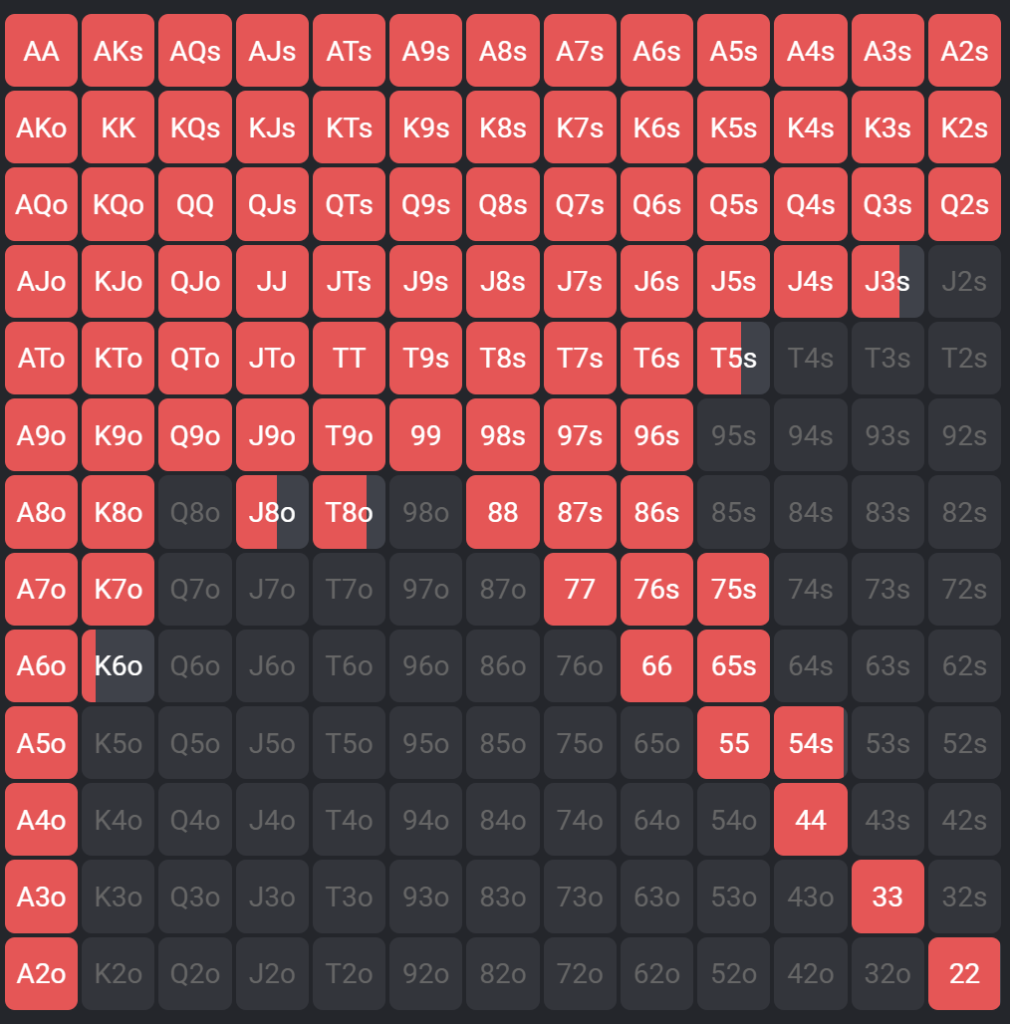
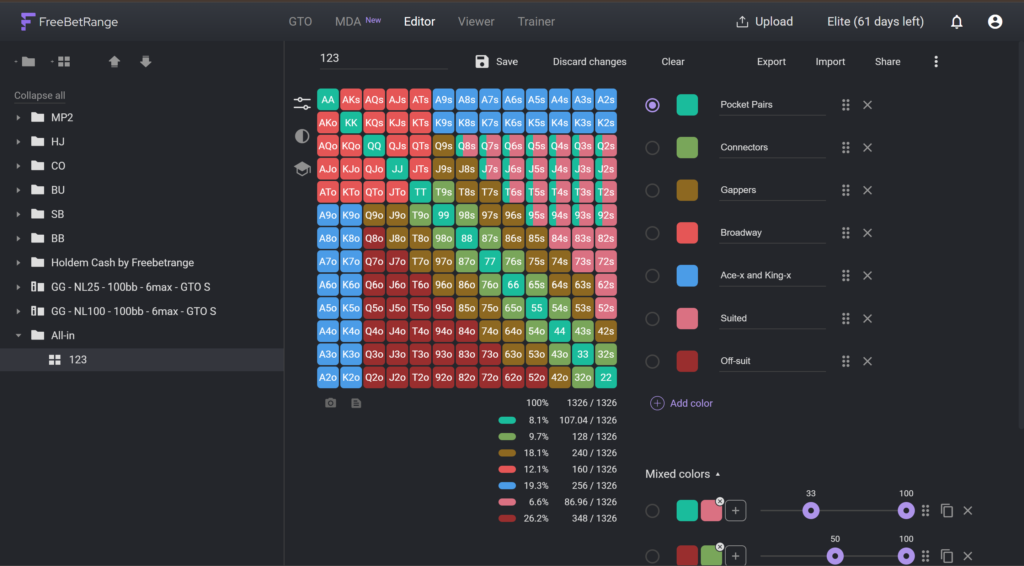
They look like a 13×13 grid: along both axes are cards from Ace to Two. Each cell represents a type of hand. Colored cells are hands you play; empty ones are folds. We also recommend checking out our guide on how to read the 13×13 poker matrix.
This is why experienced players make decisions quickly and confidently: they’ve memorized these tables for common preflop situations. They see their cards — and instantly know what to do.
Why this matters — even for beginners
You might be thinking: “This sounds complicated. Why do I need this if I’m just starting?”
Here’s the honest answer: if you want to improve at poker, you can’t avoid learning ranges. Here’s why:
1. Most preflop losses come from choosing the wrong hands. Beginners often play too many hands (“maybe I’ll get lucky”) or too few (“I’d better fold”). A solid range removes this uncertainty.
2. Ranges are the foundation of your entire strategy. Postflop play depends on the hands you enter the pot with. If your preflop game is chaotic, postflop becomes even more confusing. Learn more in our article Preflop vs. Postflop.
3. Knowing your ranges frees up mental energy. When your preflop decisions are automatic, you can focus on more advanced concepts — reading opponents, bet sizing, and table dynamics.
Why are ranges so hard to memorize?
Let’s be honest: most beginners try to learn ranges like this:
- Open a table.
- Look at it for 10 minutes.
- Close it.
- Forget everything at the table.
Why doesn’t this work? Because our brains don’t remember static images — they remember things we actively use. You need to work with a range repeatedly, in different situations, for it to stick in your memory.
The good news: that’s exactly what a trainer is for.
What is FreeBetRange and how can it help?
FreeBetRange is a poker range tool that runs directly in your browser. No downloads or installation needed.
It consists of five main sections:
1. Editor — where all your ranges are stored. You can organize them by position, stack size, and situation, customize colors and weights, and import ready-made solutions from other programs.
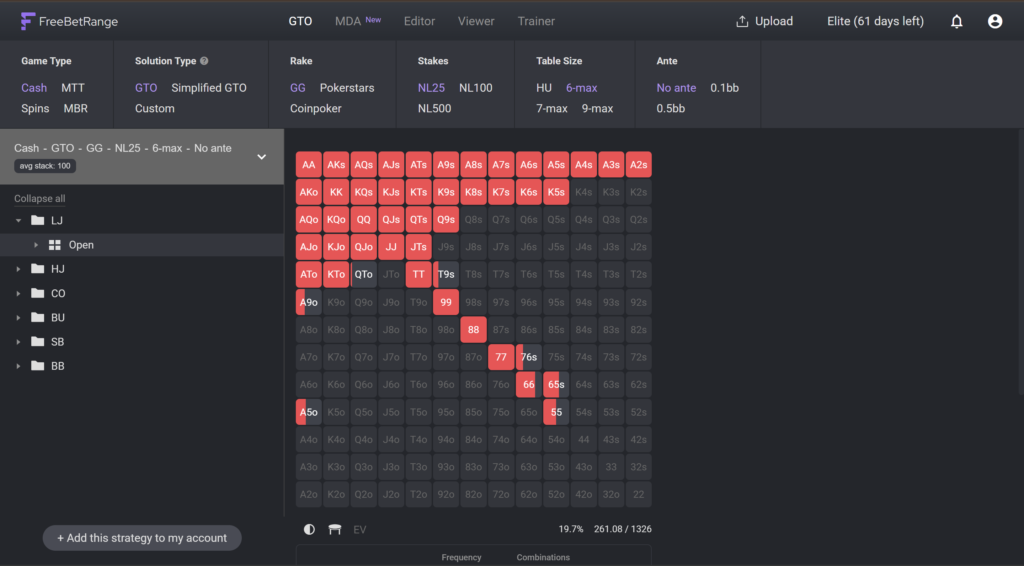
2. GTO Library — ready-to-use ranges. It includes GTO solutions for cash games, MTTs, and Spin&Go, as well as exploitative strategies from well-known coaches and players.
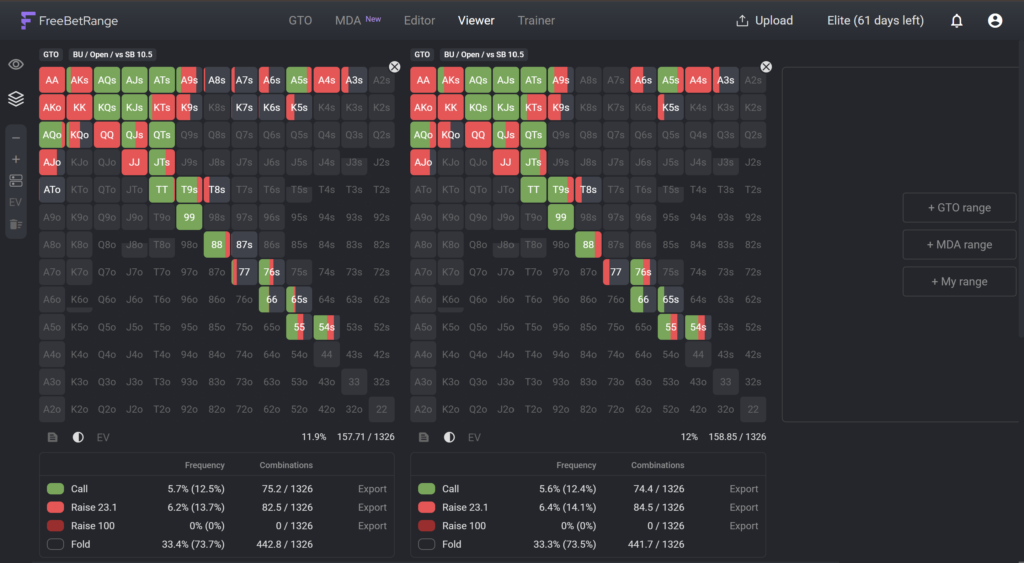
3. Viewer — a mode for viewing ranges in a clean matrix format. Open a range, study it, and get familiar with the structure.
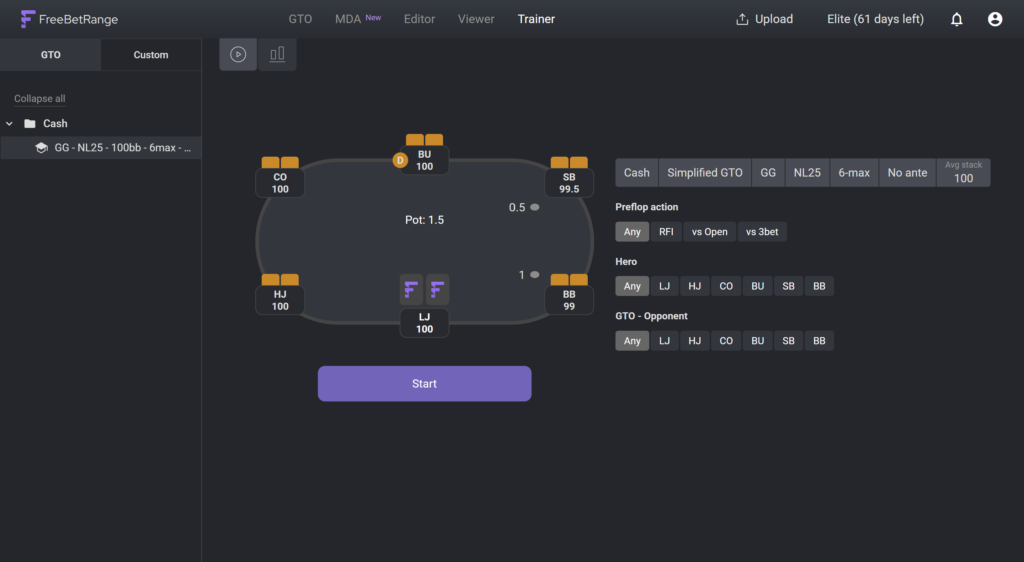
4. Trainer — the key tool for memorization. You can practice in two modes:
- Classic — you’re dealt a hand and make a decision like in a real game: raise, call, or fold. This mode builds automatic reactions.
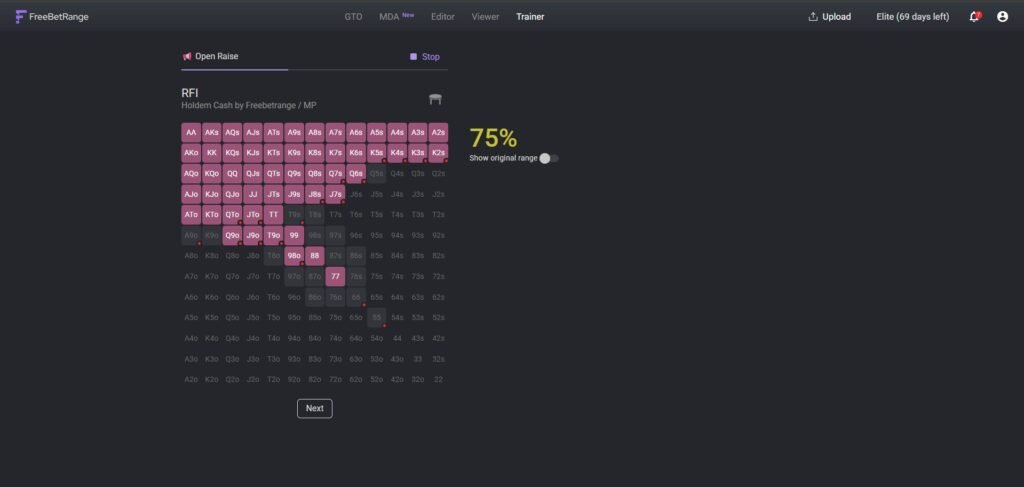
- Range-drawing — you see an empty matrix and recreate the range from memory by selecting the correct hands. A great way to test how well you’ve learned it.
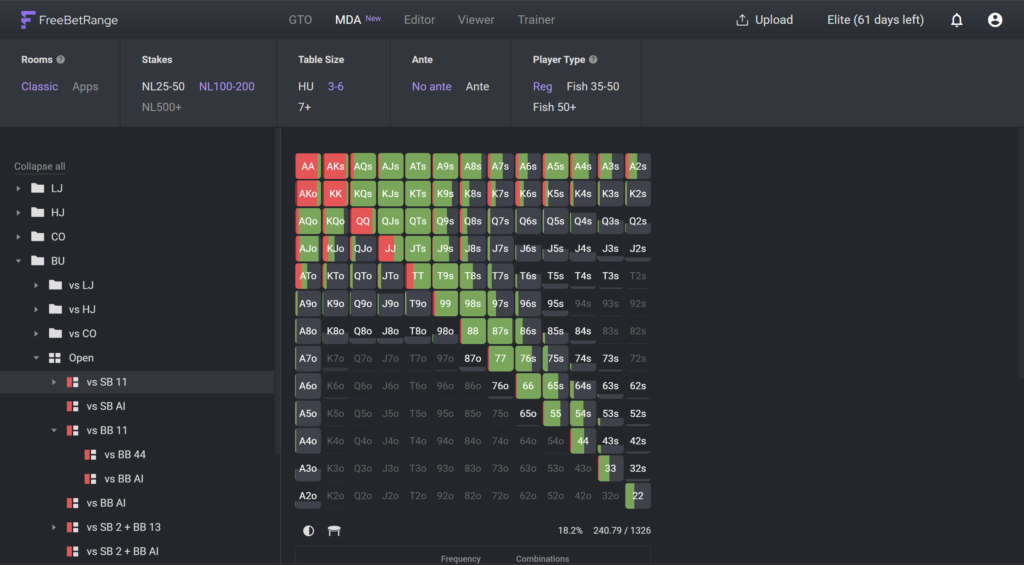
5. MDA — a newer section for those who want to understand not just theory, but how the game is actually played. More on this below.
Step-by-step plan for beginners: how to start from scratch
Step 1. Sign up and choose a plan
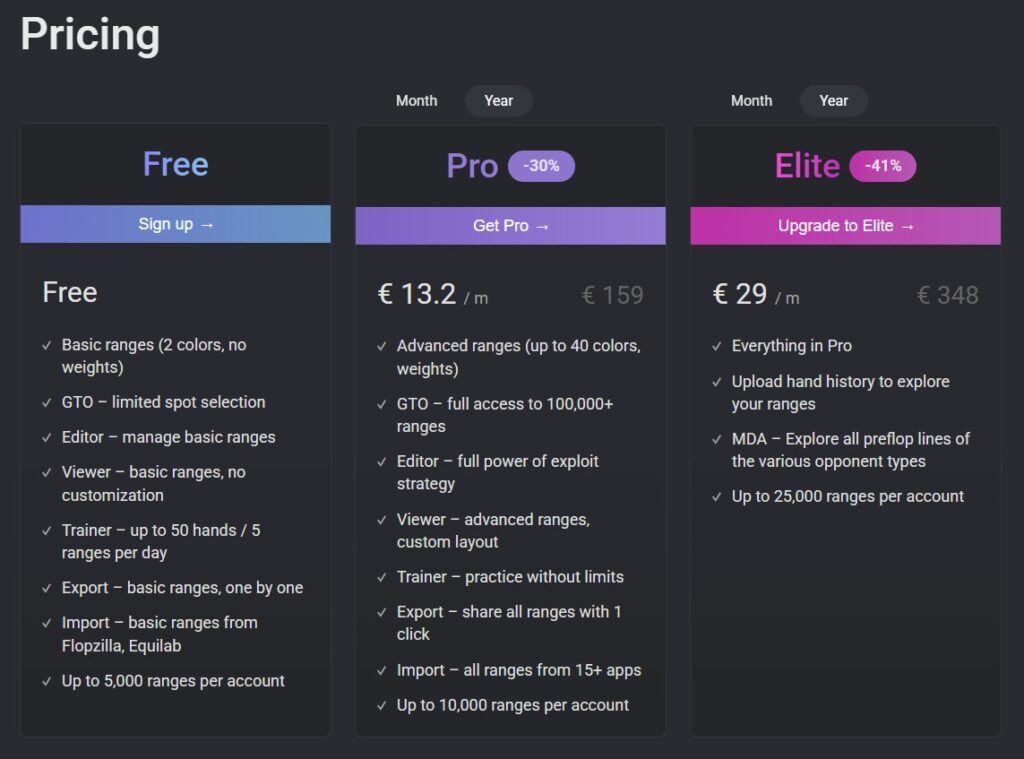
Go to Freebetrange.com and create an account. The basic (Free) plan is completely free — it gives access to core features and lets you start training right away (up to 50 hands and 5 ranges per day). For unlimited training, full Library access, and advanced imports from 15+ programs, you’ll need a Pro or Elite plan.
Step 2. Get familiar with a range via the Library or Viewer
Before training, just look at a range. For example, open a BTN open-raise range. This is the widest and most “comfortable” position — you can play the most hands here.
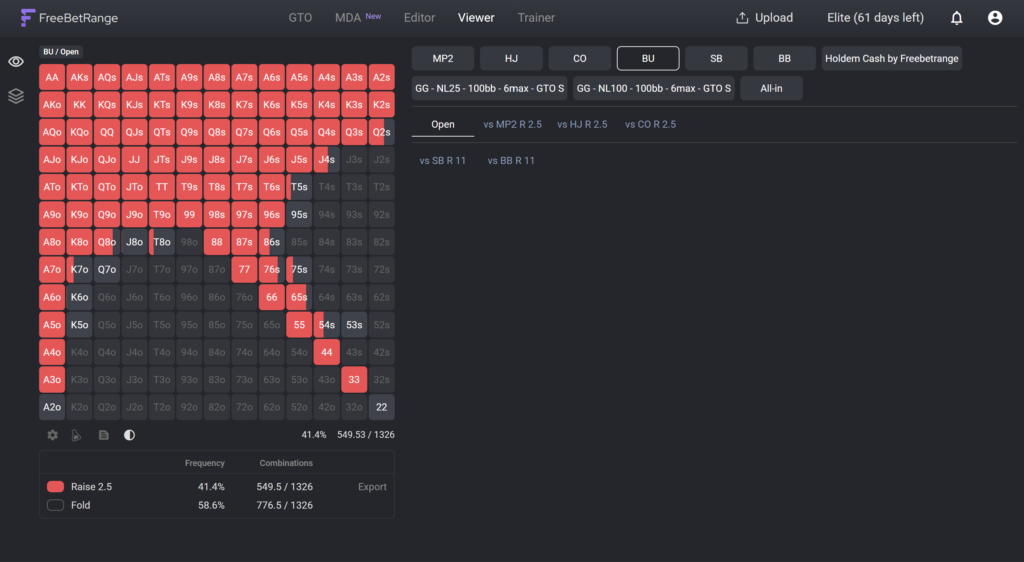
Look at the grid and try to understand the logic:
- All the “top” hands (pairs, strong high cards) are included — makes sense.
- The farther from the top-left corner, the weaker the hands.
- Suited hands are played more often than offsuit ones.
No need to memorize yet — just get the big picture. This should take 5–10 minutes.
Step 3. Start training — one range at a time
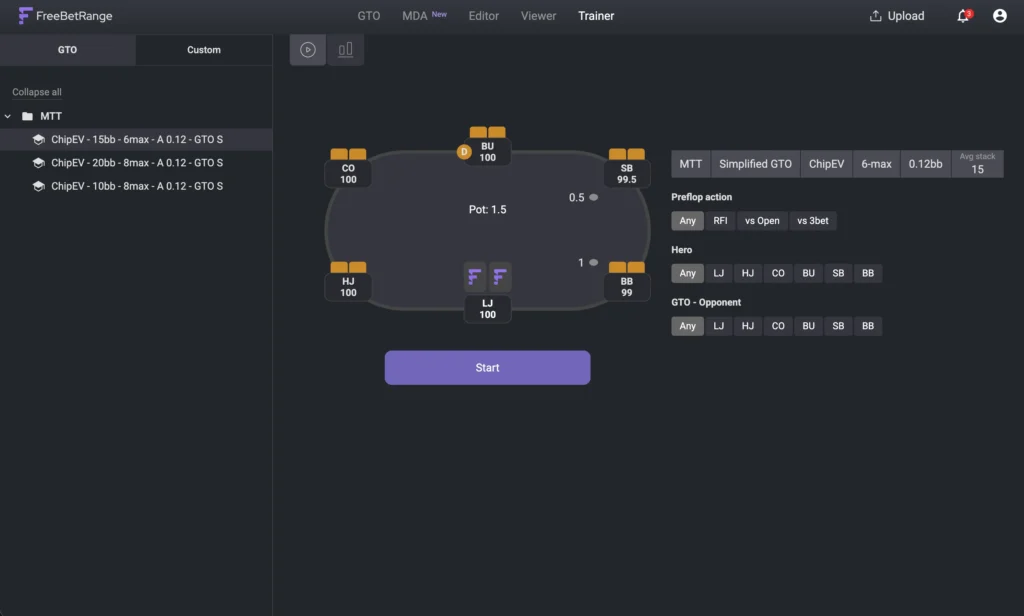
Go to the Trainer. There are ready-made exercises — open any of them, for example “BTN Open Raise.”
Start with Classic mode: you’re shown a hand and a situation, and you choose “Raise,” “Call,” or “Fold.” If you’re correct — green signal, next hand. If not — red signal, and you immediately see the correct answer.
Once basic decisions start to feel natural, try Range-drawing mode: you’ll see an empty matrix and recreate the range from memory. This is a great way to test how well you’ve actually learned it.
Practice 15–20 minutes a day with one range. Don’t overdo it — your brain gets tired, and an extra hour won’t help.
Step 4. Move on only when you’re ready
How do you know you’ve learned a range? A simple benchmark: if you get it right 8–9 times out of 10 across several sessions, you’re ready to move on.
Suggested order for beginners:
- BTN open — the widest range and a great starting point.
- CO open — slightly tighter but similar structure.
- HJ and UTG open — tighter ranges with straightforward logic.
- SB open (vs BB) — a unique range, study it separately.
- Calls vs raises — start with BTN and CO.
Don’t rush. It’s better to learn 3 ranges well than 10 poorly.
Step 5. Keep ranges open while playing
At the beginning, this is completely normal and even recommended. While you’re still learning, keep FreeBetRange open in your browser next to your poker client. Check the range before making each decision.
Over time, you’ll rely on it less and less — because the answers will come automatically. That’s what “learning ranges” really means.
What if something just won’t stick?
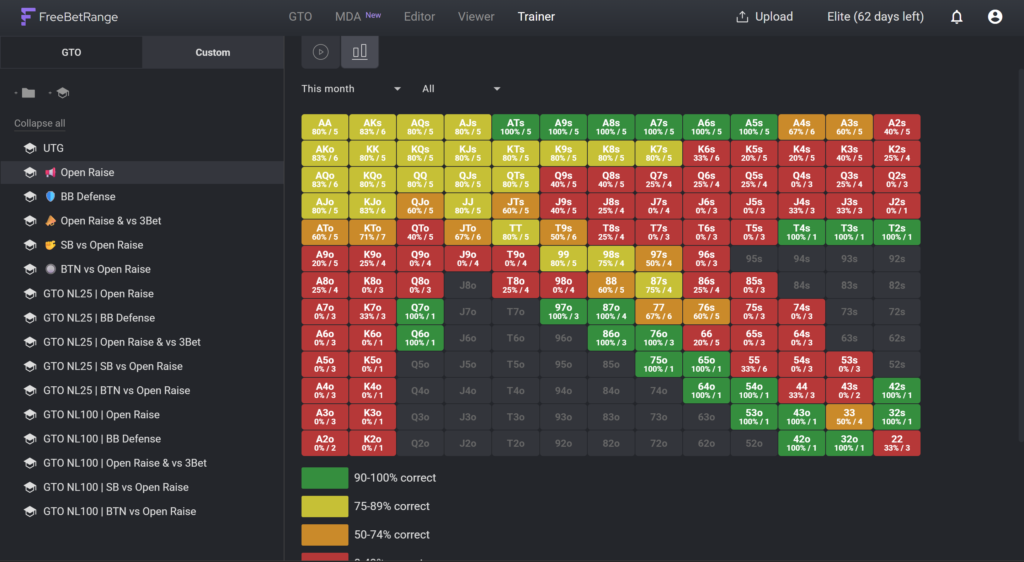
Sometimes certain hands just don’t stick in your memory — for example, you keep forgetting whether Q9o is included or not.
FreeBetRange has a helpful heatmap that shows which hands you struggle with most. You can create a small exercise focused only on these “problem” hands and work on them separately.
MDA: understanding how real opponents play
It’s also worth highlighting a newer section of FreeBetRange — MDA (Mass Data Analysis).
This is a completely different perspective on ranges. While the Library shows how you should play according to GTO, MDA shows how real players actually play at the tables.
MDA is based on the analysis of more than 300 million real hands from cash games. For each spot, you can view the actual ranges of different player types: regulars, loose players with VPIP 35–50, or very loose players with VPIP 50+. The data is also split by platform type (traditional poker rooms or poker apps) and stakes (NL25-50, NL100-200, NL500+).
Why is this useful? When you know which hands an average recreational player enters the pot with from a given position at a specific limit, you can build much more precise exploitative strategies — instead of guessing your opponent’s range. Any MDA range can be exported in one click and loaded into a solver to calculate counter-strategies.
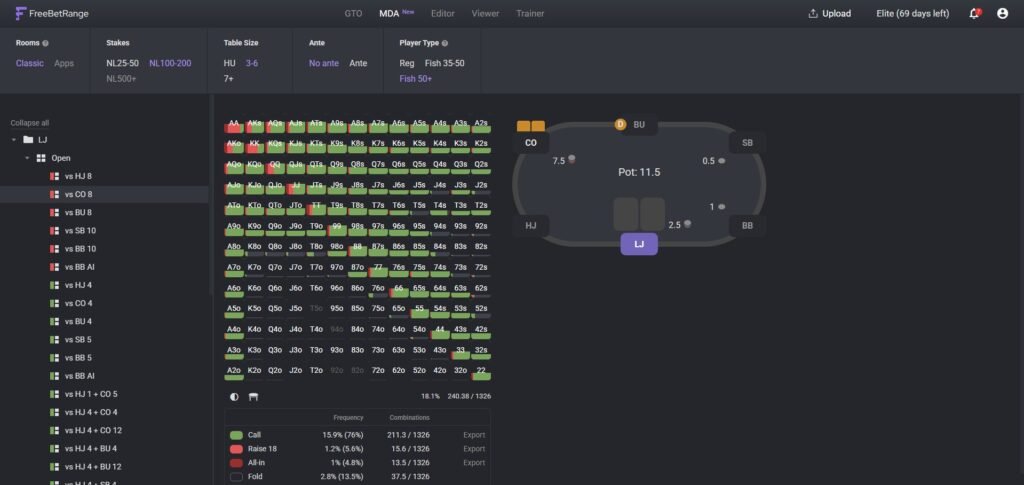
MDA is available in the Elite plan. In the free plan, one spot is unlocked for preview — LJ open-raise at NL25-50.
Practical tips for beginners
Practice every day, even a little. 15 minutes daily is far better than 2 hours once a week. Consistency builds long-term memory.
Don’t try to learn everything at once. There are many ranges. Start with open-raises — mastering them alone will already improve your results significantly.
Try explaining a range out loud. Close the grid and describe it in words: “From BTN, I open about a third of hands — all pairs, strong broadways, suited connectors down to…”. If you can explain it, you understand it.
Don’t be afraid to check ranges during play. It’s not cheating — it’s learning. Professionals spent years training to no longer need help — you have time to get there too.
Conclusion: getting started is easier than it seems
Learning ranges isn’t magic or something reserved for a select few. It’s simply a skill built with the right tools and consistent practice.
FreeBetRange brings everything together in one place: an Editor to store and customize ranges, a Library with GTO and exploitative solutions, a Trainer with two modes for real memorization, a heatmap to fix mistakes — and MDA to understand how your opponents actually play.
Start now at Freebetrange.com — the basic plan is free, and registration takes just a minute.
Master GTO preflop strategy, build your own ranges, and train smarter — all in one powerful tool.
Try FreeBetRange