Preflop vs Postflop: Where Money Is Made in Poker
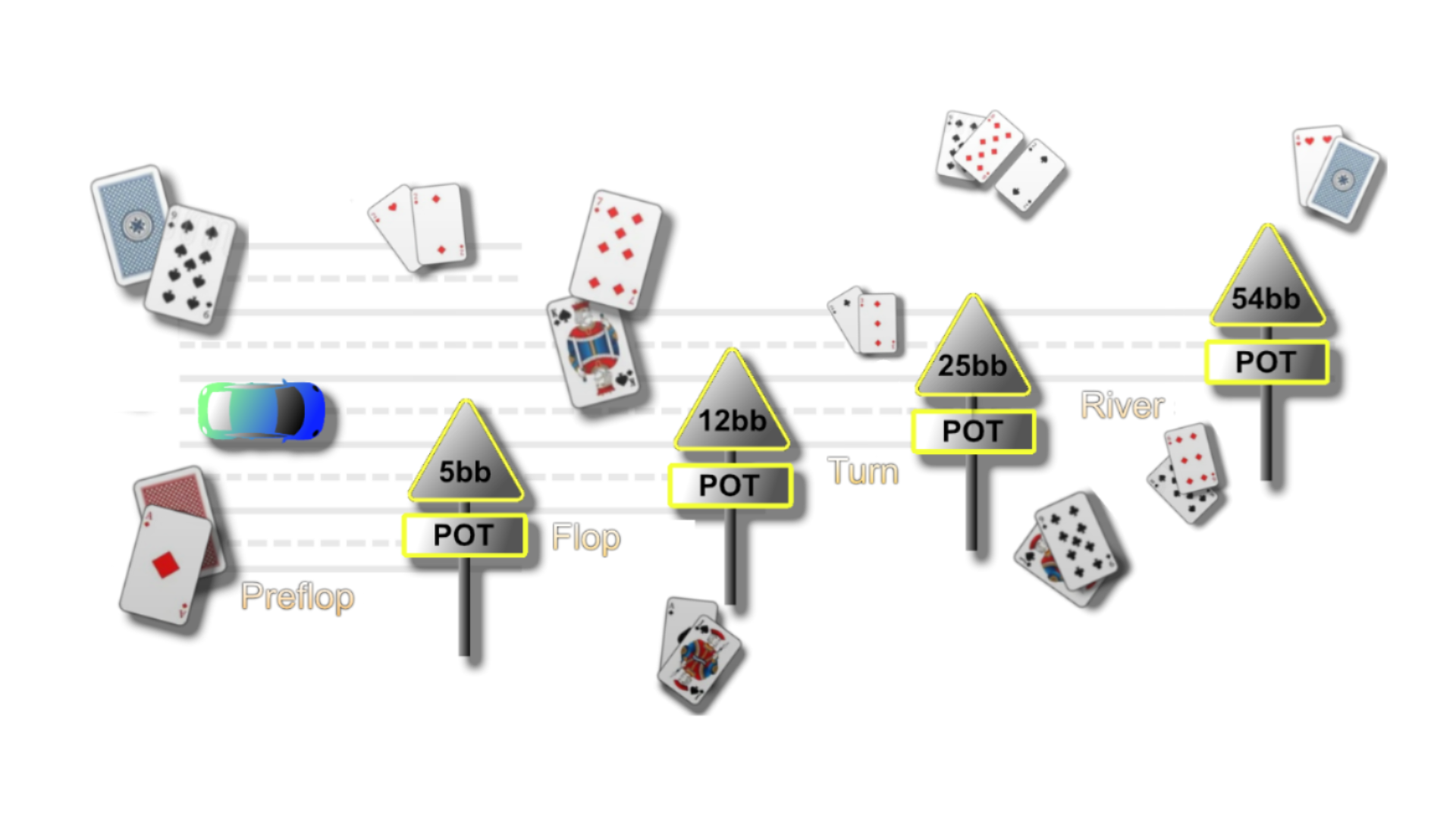
Among poker players, there’s a persistent belief: “preflop is just a formality — the money is made postflop.” You can hear this from both recreational players and — surprisingly — even from mid-stakes regulars. At first glance, it seems logical: the biggest pots are played on the flop, turn, and river, the toughest decisions are made there, and that’s where the skill gap appears most noticeable.
But if you take a closer look, the picture changes.
In this article, we’ll break down how preflop and postflop are actually connected, why mistakes made before the flop are more expensive than they seem, and where to start if you want to improve your game systematically.
Each street has its role
A poker hand is a sequence of decisions. Each street has its own function.
Preflop is selection. This is where a player decides whether to enter the pot at all, with what intention, and with what sizing. The structure of the pot and the composition of ranges are formed here.
Flop is about evaluating how ranges connect with the board. A player’s range interacts with three community cards. This is where the first serious postflop decisions are made.
Turn is refinement. The fourth card often shifts the balance of power, and the pot grows.
River is the final stage. The most expensive decisions, the highest variance, and the greatest earning potential in absolute terms.
If you only look at pot sizes, postflop does carry more weight — the money is bigger there. But if you look at who creates the conditions for that money, it’s preflop.
What happens when you enter the pot with the wrong hand
Here’s a concrete scenario.
You’re in MP. UTG opens. You decide to call with KJo.
At first glance, it looks like a decent hand. But UTG’s opening range includes AA, KK, QQ, JJ, AK, AQ, AJ, KQ. Against this range, your KJo has about 37–38% equity. That means you’re already at a structural disadvantage before the flop.
The flop comes K♠ 9♣ 4♦. You’ve hit top pair, but with a weak kicker. UTG bets. What do they have? Their range includes KK (set), KQ (better kicker), AK (better kicker), 99 (set), JJ. Most of the hands they continue betting with beat you. Most of the hands worse than yours were already folded preflop.
You’re in a classic dominated hand situation: folding feels too tight, but continuing is dangerous. The problem didn’t arise on the flop — it was created preflop, when you called with KJo in a spot where you shouldn’t have.
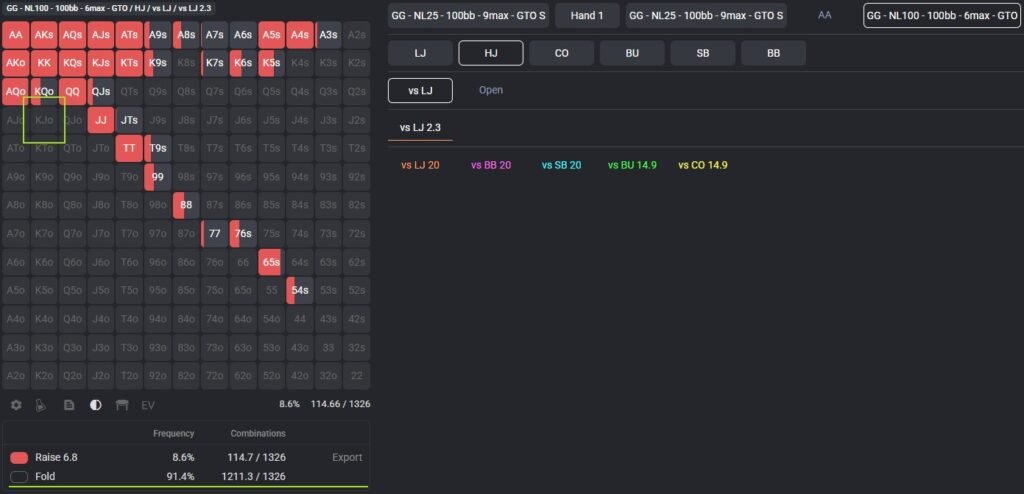
The image below shows a correct example of an MP range versus an early position open.
How good preflop simplifies postflop
The flip side of the same coin: when you enter the pot with the right hand, postflop becomes easier — not because you suddenly play better, but because you more often find yourself in objectively favorable situations.
Here are a few concrete consequences.
- You face dominated situations less often. If you only call 3-bets with hands that have sufficient equity and playability, you’ll less frequently end up in impossible flop spots where your hand technically “hits” but loses to most of your opponent’s continuing range.
- You have range advantage more often. If you open from UTG with a proper tight range (AA–88, AK, AQ, AJ, KQ…) instead of playing too wide, your range will be objectively stronger on many boards than that of a BTN player calling with a wide range.
- You’re less often out of position with marginal hands. One of the most expensive situations is being out of position with a hand that “might be best, or might not.” Good preflop play reduces how often this happens.
- You enter the pot with initiative. The player who raises has the option to continuation bet. The player who calls does not. On many boards, initiative plus a strong range equals the ability to win the pot without a showdown.
Why preflop mistakes are costly — a frequency perspective
A preflop decision is made in every single hand. Without exception. If you make a systematic mistake — for example, calling too wide from early positions — that mistake works against you constantly, throughout the entire session, over and over again.
Postflop mistakes are also expensive. But they only occur in hands where you’ve already made it past preflop. By nature, they are less repetitive — boards differ, situations vary.
A systematic preflop mistake with “every hand” frequency is a leak that cannot be fully compensated even by very strong postflop play. A player with perfect postflop but weak preflop is extremely rare — and for good reason: quality postflop requires quality inputs. If you repeatedly enter pots in structurally losing situations, no amount of technical skill postflop will fully make up for that deficit.
So where is the money?
The honest answer: on every street, but in different ways.
Preflop is the area with the best “study effort to results” ratio. There are precise, calculated answers here: opening ranges by position, 3-bet ranges, blind defense strategies. All of this can be studied, trained, and automated — providing a consistent, cumulative edge in every session.
Postflop is where the greatest exploitative potential and creativity lie. This is where strong players pull away from average ones. But to unlock that potential, you need a foundation — and that foundation is built preflop.
Professionals spend so much time studying ranges not because postflop is uninteresting to them, but because preflop is a prerequisite for good postflop — and at the same time, it can be studied in a precise and repeatable way. That’s a rare combination.
Practical application: where to start
If you want to improve your game systematically, here’s a structured path.
- Start with positions. Understand which hands are opened from each position — and why. Don’t just memorize ranges blindly; break down the logic: why UTG plays tight and BTN plays wide. This understanding matters more than memorizing a chart.
- Learn basic response ranges. How to react to a 3-bet: call, 4-bet, or fold. How to defend the big blind. How squeezes work. This is the next layer of your foundation.
- Train decision-making, not just reading ranges. Knowing a range and applying it at the table are fundamentally different skills. A brain that knows the rule and a brain that executes it under pressure are not the same. You need practice in conditions close to real play.
- Move on to postflop with an understanding of the range you entered the pot with — this changes everything. When you know which hands are in your range and why, postflop decisions become structured rather than intuitive guesses.
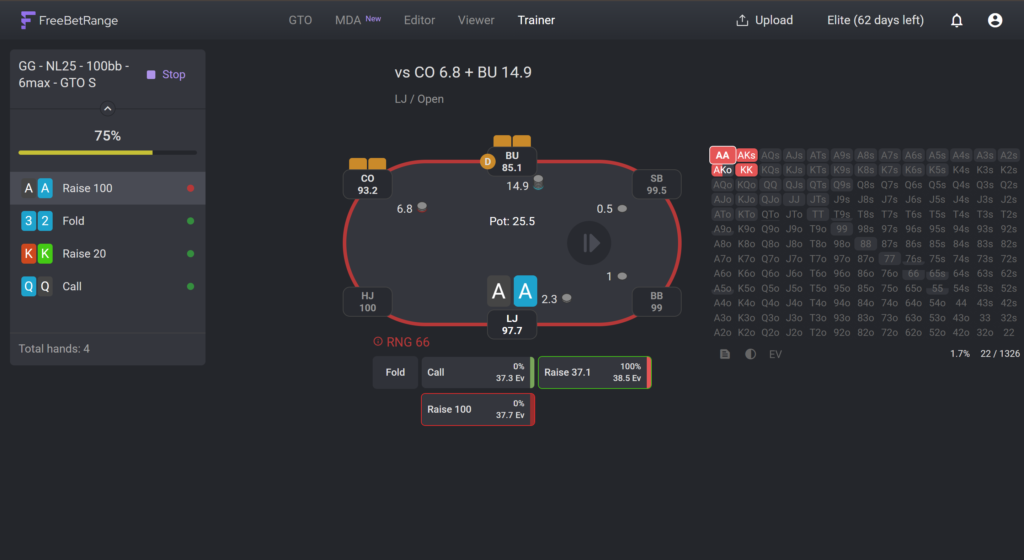
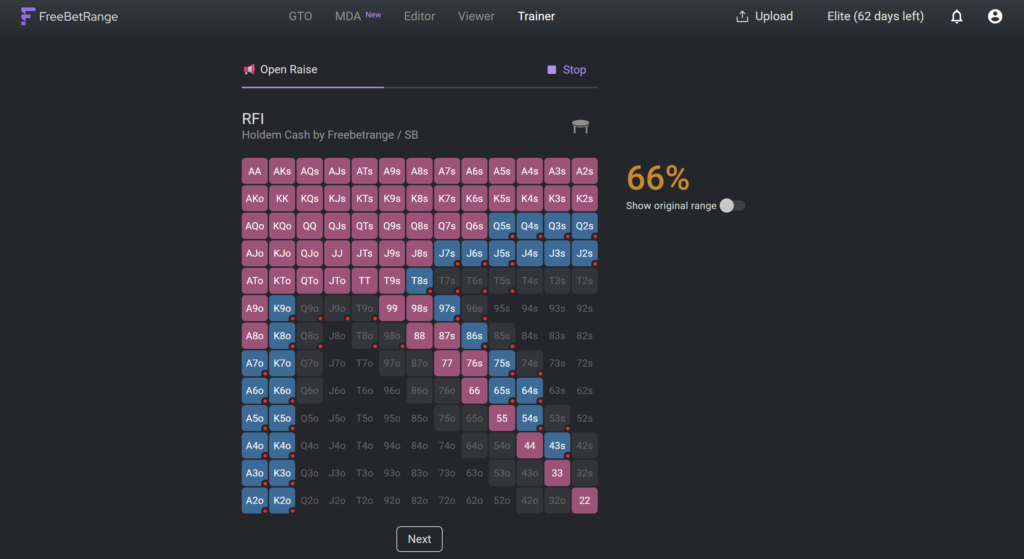
FreeBetRange is built exactly for this path. The library contains ready-made ranges for every position, format, and stack depth. The trainer lets you practice decisions in a mode that closely mirrors real gameplay. You can start from any position and any level of understanding — and build your skill systematically, rather than by trial and error.
Conclusion
The question “preflop or postflop?” is fundamentally the wrong question. It’s not a competition between two streets for the title of “most important.” It’s about how one street creates the conditions for the next — and why understanding this connection is essential for progressing as a player.
It’s important to understand: postflop does not exist in a vacuum. Every postflop situation is a direct consequence of who entered the pot, with what hands, and how they did so preflop. Range advantage on the flop, initiative, position, stack-to-pot ratio — all of this is determined before the dealer puts out the first community card.
That’s why working on preflop delivers such strong returns. Not because postflop doesn’t matter, but because good preflop systematically improves every postflop situation you find yourself in. You face dominated hands less often. You have range advantage more frequently. You act more often with position and initiative. Postflop becomes less about survival and more about realizing an existing edge.
This means that investing time in studying preflop ranges is one of the most rational things a poker player can do to improve results — especially on the journey from beginner to solid regular.
Money in poker is made on every street. But it’s most often lost before the first community card is even dealt. And the sooner you understand that, the faster real progress begins.

Master GTO preflop strategy, build your own ranges, and train smarter — all in one powerful tool.
Try FreeBetRange