Combinatorics in Poker: What It Is and How to Count Combos
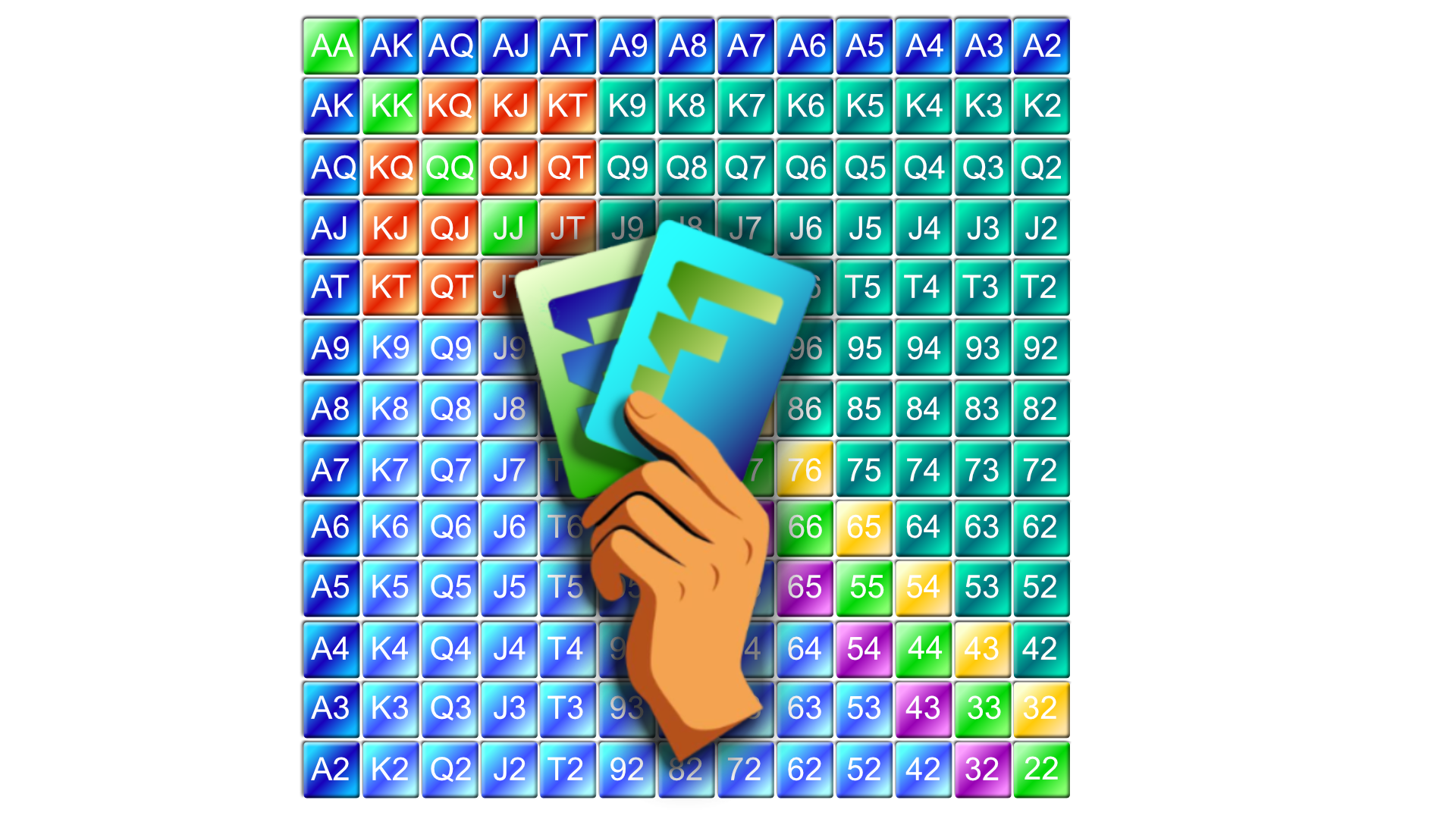
You’ve probably heard the word “combinatorics,” but never quite dug into what it actually means. It’s one of those fundamental concepts that sounds intimidating at first—but is actually very simple. No complicated formulas. Just three numbers to remember and an understanding of how to use them. After reading this article, you’ll start thinking about your opponent’s ranges differently: not “maybe they have AA, maybe not,” but “how often does AA appear in their range compared to other hands?” That’s real poker thinking.
Let’s start with a simple question
Imagine you’re looking at your opponent and thinking: “Could they have AA?”
The answer “yes, they could” is too vague. It’s much more useful to evaluate how likely AA is for your opponent—and how often AA appears compared to other hands.
That’s exactly what combinatorics is for. Don’t worry—no complex math. You only need to remember three numbers.
First: what is a “hand combination”?
In poker, you have two hole cards. “AA” is not a single specific hand—it’s any two aces out of the four in the deck.
Aces come in four suits: ♠ (spades), ♥ (hearts), ♦ (diamonds), ♣ (clubs).
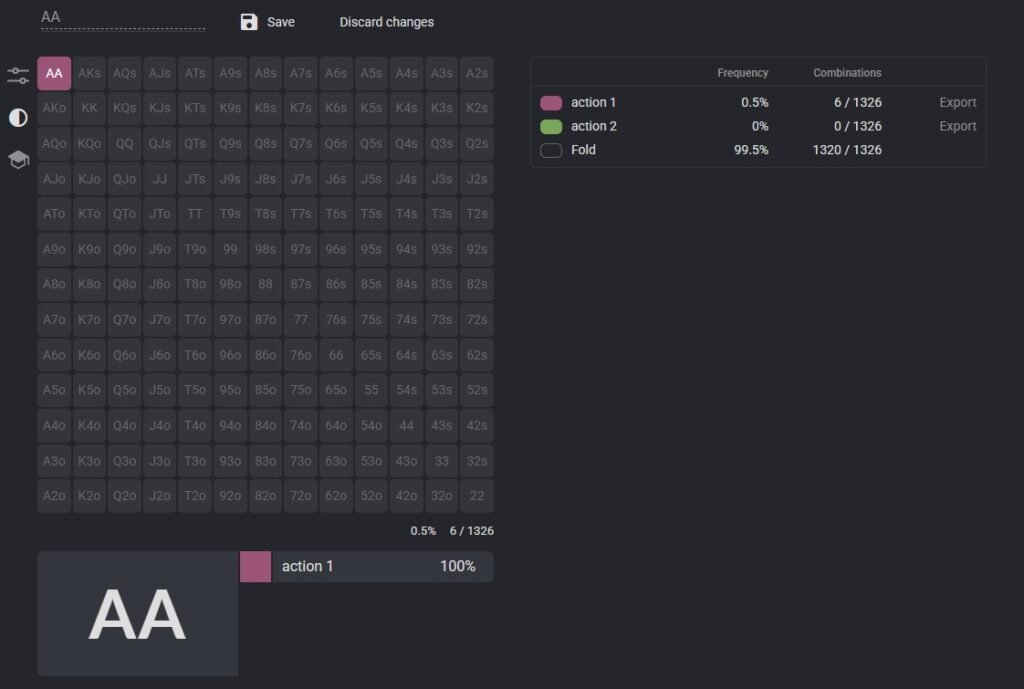
So “getting AA” means getting any two of those four aces. And there are exactly 6 such combinations:
- A♠ + A♥
- A♠ + A♦
- A♠ + A♣
- A♥ + A♦
- A♥ + A♣
- A♦ + A♣
These six options are called the 6 combinations of AA.
This rule applies to ANY pair—KK has 6, QQ has 6, 22 has 6. Every rank has exactly 4 suits, and choosing any 2 out of 4 always gives 6 combinations.
Easy to remember: a pair = 6 combinations.
Now let’s look at suited hands
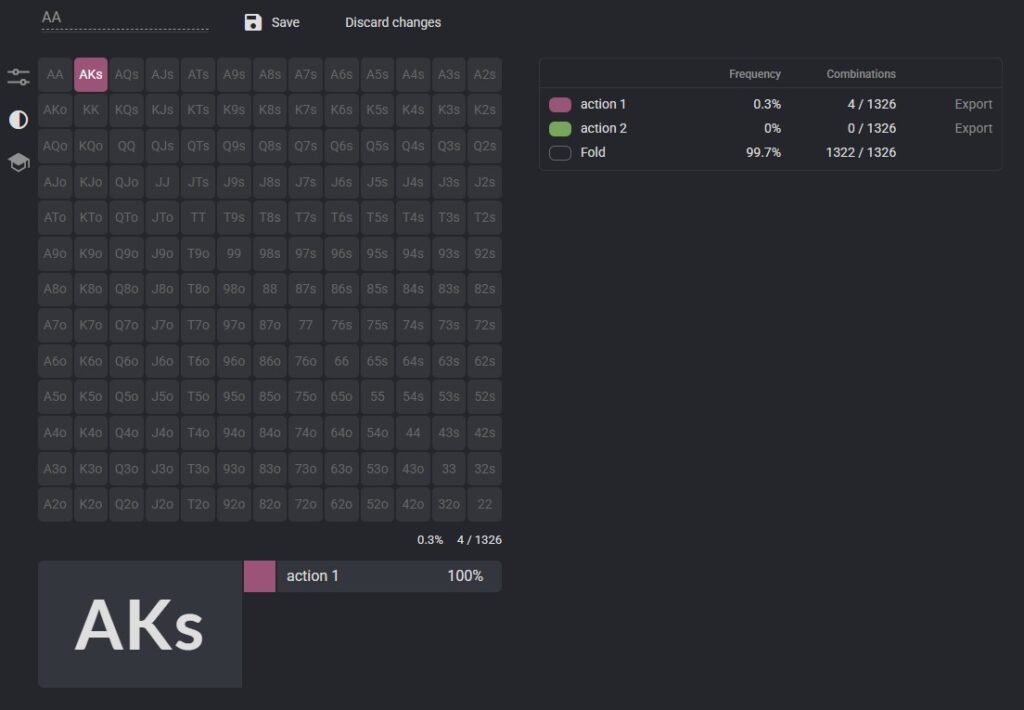
Take AKs—an ace and a king of the same suit.
Same suit means both cards must be spades, or both hearts, and so on. How many combinations are there?
- A♠ + K♠
- A♥ + K♥
- A♦ + K♦
- A♣ + K♣
Exactly 4 combinations—one for each suit.
This works for any suited hand: 76s, QJs, T9s—each has exactly 4 combinations.
And finally: offsuit hands
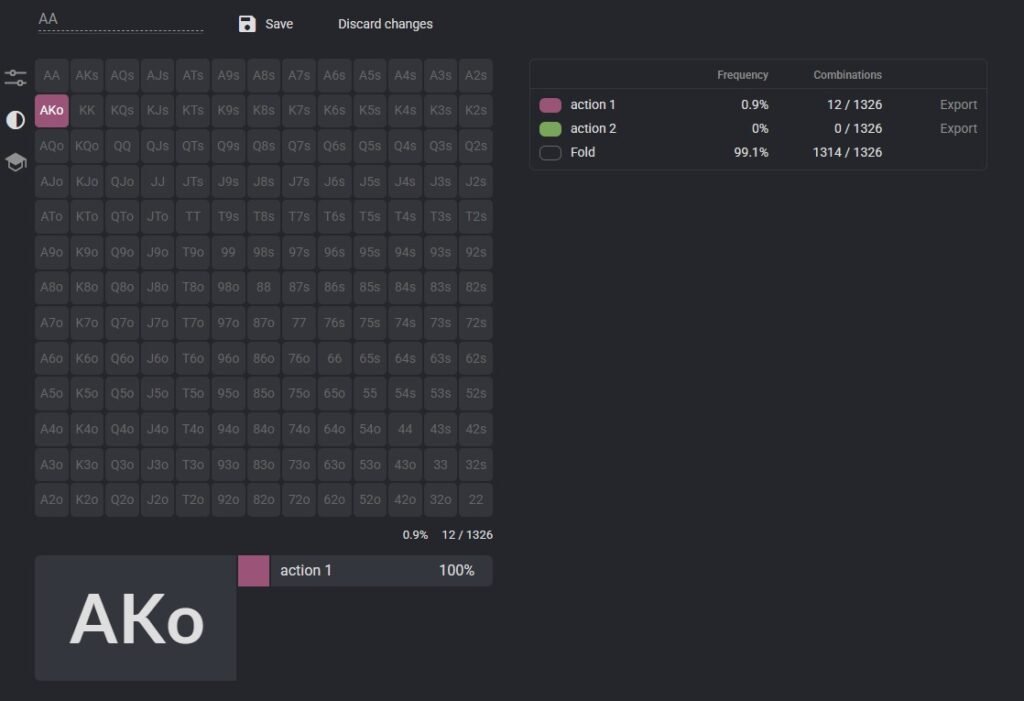
Now AKo—an ace and a king of different suits.
There are many more possibilities here because the suits can differ:
- A♠ + K♥, A♠ + K♦, A♠ + K♣ (3 combinations with the ace of spades)
- A♥ + K♠, A♥ + K♦, A♥ + K♣ (3 combinations with the ace of hearts)
- A♦ + K♠, A♦ + K♥, A♦ + K♣ (3 combinations with the ace of diamonds)
- A♣ + K♠, A♣ + K♥, A♣ + K♦ (3 combinations with the ace of clubs)
Total: 4 × 3 = 12 combinations.
An offsuit hand appears three times more often than the same suited hand!
The three numbers you need to know
| Hand type | Example | Number of combinations |
|---|---|---|
| Pair | AA, KK, 22 | 6 |
| Suited | AKs, QTs | 4 |
| Offsuit | AKo, QTo | 12 |
That’s it! Everything else is just applying these three numbers.
Why this matters — a simple example
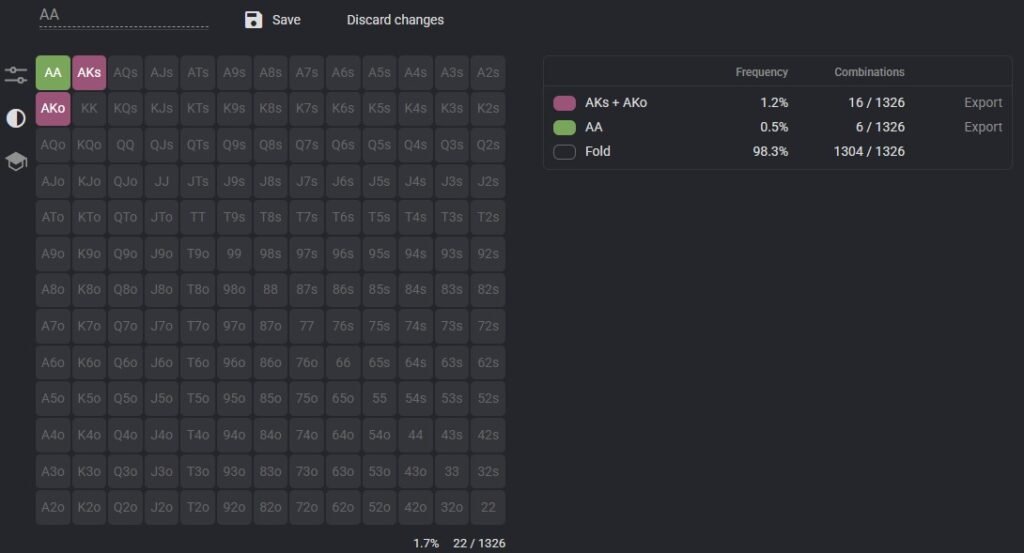
Imagine you’re thinking: could your opponent have AA or AK when they make a big bet?
Let’s count:
- AA: 6 combinations
- AKs: 4 combinations
- AKo: 12 combinations
Total AK (all versions): 16 combinations.
So AK appears almost three times as often as AA! This already helps you think more precisely about your opponent’s range.
Blockers: your cards affect your opponent’s range
Here’s an interesting point. Suppose you hold an ace. That means your opponent cannot have all 6 combinations of AA—you have one of the aces! They only have 3 combinations of AA available (from the remaining three aces in the deck).
This is called a blocker. Your cards “block” some of your opponent’s possible hands.
You hold an ace? Your opponent has half as many AA combinations. You hold the ace of spades? Your opponent has zero suited hands with the ace of spades.
It might sound minor, but professionals constantly use blockers when making decisions—especially when considering whether to bluff.
How many total starting combinations are there in poker?
There are 52 cards in the deck, and you choose 2. The total number of unique combinations is 1326.
Why does this matter? Because when we say “the opponent opens 10% of hands,” that’s about 133 combinations out of 1326. Knowing how many combinations each specific hand has helps you understand what actually makes up that 10%.
How to use this at the table
You don’t need to calculate everything in your head during a hand. First, just get used to thinking in terms of “how many combinations could my opponent have?”
Three simple questions help:
- Is it a pair, suited, or offsuit? → Instantly: 6, 4, or 12.
- Do I have a blocker? → If yes, reduce the number accordingly.
- How many value hands vs. how many bluffs are in the opponent’s range? → Combinatorics gives a clear answer.
FreeBetRange does the counting for you
When you study ranges using FreeBetRange, you see the number of combinations automatically. Any selected range immediately shows:
- The exact number of combinations
- The percentage out of all 1326 possible hands
- A visual distribution in the matrix
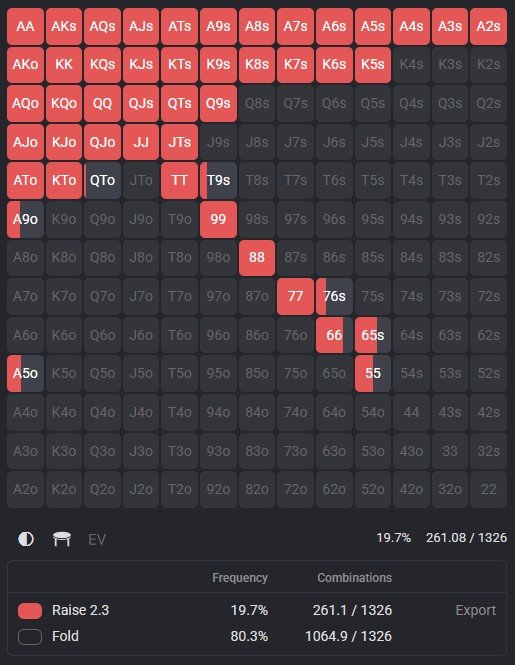
This is a great way to learn: open a range, look at a BTN opening range, and immediately see—here are 250 combinations, which is 18.9% of hands. You start to feel how wide or tight a position plays.
Summary
Combinatorics is simply the ability to count how many real combinations are behind each “hand” in a range.
- Pairs: always 6 combinations
- Suited: always 4 combinations
- Offsuit: always 12 combinations
- Total starting combinations: 1326
With this knowledge, you’ll stop thinking “maybe they have AA, maybe not” and start thinking “how likely is AA compared to other hands in their range?” And that’s real poker thinking.

Master GTO preflop strategy, build your own ranges, and train smarter — all in one powerful tool.
Try FreeBetRange