Marginal Hands Preflop: How to Make Profitable Decisions
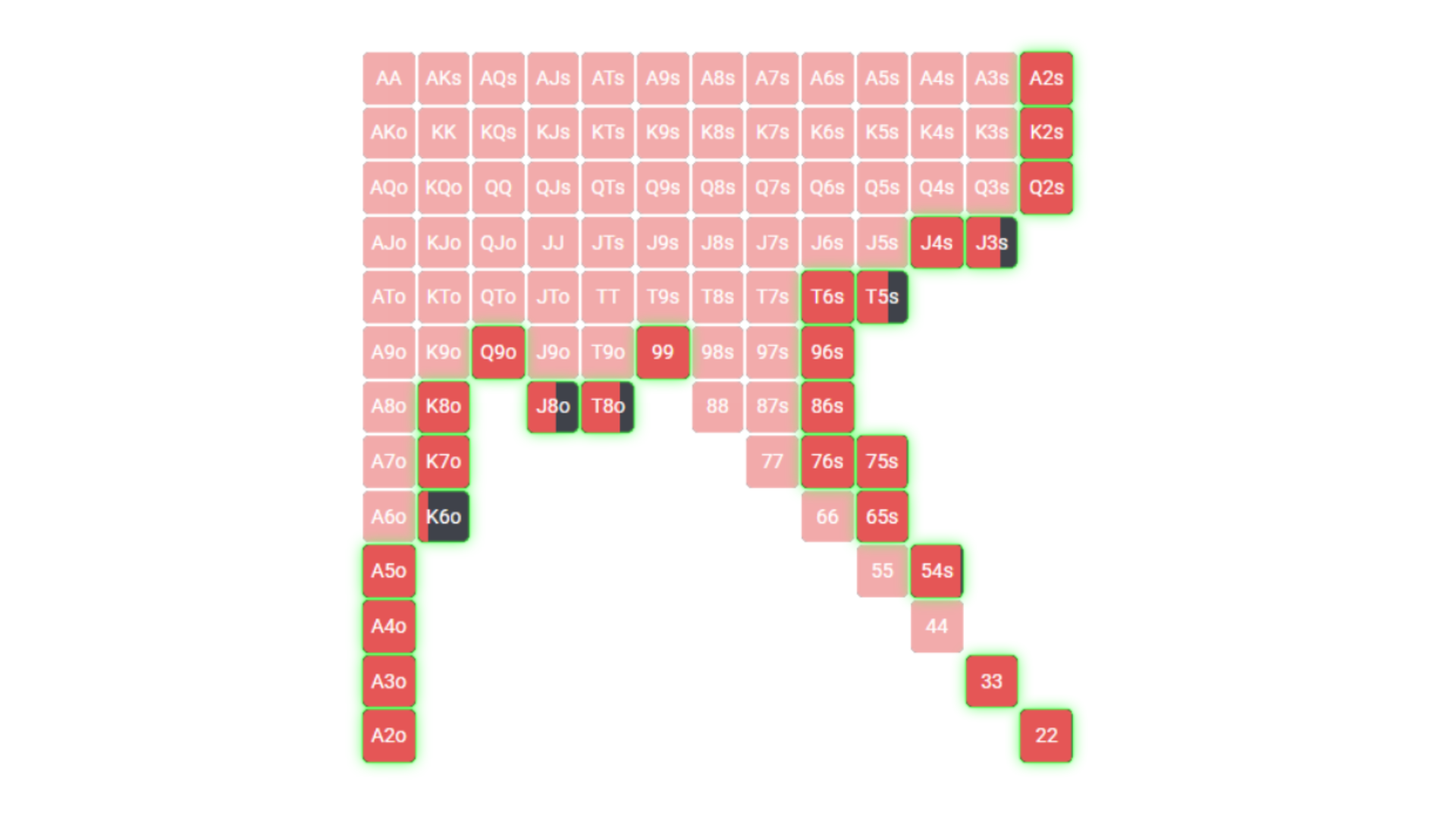
Anyone who seriously studies ranges eventually runs into the same problem: there are hands where the decision is obvious — AA is always an open, 72o is always a fold. But between them lies a whole zone of hands with no clear answer. KJo from HJ — open or not? 76s from MP — is it worth it? A4s — where’s the cutoff?
These hands are called marginal. And they’re the ones that most often lead to mistakes — not because players don’t know the theory, but because decisions with them are made intuitively and inconsistently. One time you open, the next time you don’t, and the third time it’s “well, depends how I feel.”
In this article, we’ll break down what makes a hand marginal, what factors influence the decision, and how to build a systematic approach that works at real tables.
What is a marginal hand
Imagine your CO opening range as a list of hands sorted by profitability in a given situation. At the top are obviously strong hands: AA, KK, AKs. At the bottom are clearly weak ones: 72o, 83o. And in between is a wide gray area where the EV (expected value) of opening hovers around zero.
This gray area is exactly the zone of marginal hands.
A typical sign of a marginal hand at the table: when you see it, your first thought is “what do I even do with this?” If that question doesn’t come up with AA or 72o — you’re looking at a marginal hand.
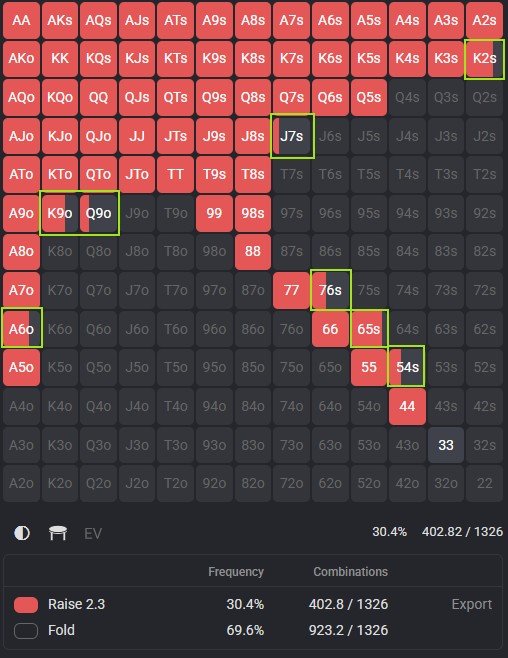
GTO solvers reflect this uncertainty through mixed strategies. When a solver shows that K9o from CO should be opened 40–50% of the time, it’s a clear signal: the hand sits right on the edge of the range, and both options (open or fold) have roughly the same EV. In practice, this means there’s no single “correct” answer — the decision depends on the situation.
Why the edge of a range is a zone, not a line
Many players think of a range as having a sharp cutoff: “I open these hands, I don’t open those.” In reality, it’s more accurate to think of a 5–10 hand-wide zone of uncertainty where the decision is not fixed.
This explains why two strong players can have slightly different ranges from the same position and both be right. One includes KJo from HJ, the other doesn’t. Under similar conditions, the EV difference between these approaches is minimal.
An important practical takeaway: when playing against real opponents who are far from GTO, mixing marginal hands (sometimes opening, sometimes not) matters less than making a consistent decision for each hand. Either always open KJo from HJ — or never. The key is not to rethink it every time at the table.
Three key decision criteria
When you’re dealt a marginal hand, there are three questions to ask in sequence. Together, they cover most situations and provide a solid foundation for making consistent decisions.
Criterion 1: Position
This is the most important factor — in many cases, it determines the decision on its own. The same hand can be a clear open on the BTN and a clear fold from UTG.
Why does position matter so much? Two mechanisms.
Fold equity when opening. From the BTN, only SB and BB are left to act. From UTG, there are 5–7 players behind you. That means you pick up the pot uncontested far more often from the BTN. With marginal hands, fold equity is your ally on the BTN — and almost nonexistent from UTG.
Postflop position. In position, you always act after your opponent, giving you a huge informational advantage: you see their check or bet before deciding. This helps you realize your hand’s equity more effectively. A marginal hand that’s profitable IP (in position) often loses that edge OOP (out of position).
A simple guideline using KTo:
| Position | Decision |
|---|---|
| UTG | ❌ Out of range |
| MP | ⚠️ Depends on table |
| HJ | ⚠️ Depends on table |
| CO | ✅ In range |
| BTN | ✅ In range |
Rule: the later your position, the more marginal hands enter your range.
Criterion 2: Stack depth
Stack depth changes the value of different types of marginal hands — and not equally.
Speculative hands (small pairs, suited connectors) benefit from deeper stacks due to implied odds — the potential to win big pots when you hit strong hands. At 150bb, a small pair is playable from a wide range of positions: flopping a set can win a huge pot. At 30bb, that upside almost disappears — the investment is the same, but the potential payoff is limited.
Offsuit broadways (KJo, QJo, KTo) are less sensitive to stack depth because their value comes from high card strength, not drawing potential.
| Hand type | 100bb | 60bb | 40bb |
|---|---|---|---|
| Small pairs 22–44 | Standard from HJ+ | Tighten | BTN only |
| Suited connectors 54s–76s | Standard from HJ+ | Slightly tighter | CO/BTN only |
| KJo, QJo | Standard from HJ/CO | Standard from CO | CO/BTN with caution |
Rule: below 40bb, be cautious with speculative marginal hands — they lose much of their value.
Criterion 3: Player pool
This is the most dynamic factor and varies from table to table. The GTO edge of a range assumes a perfectly balanced opponent. In real games, that edge shifts.
Add marginal hands if:
- There are weak, passive players at the table (especially in the blinds) — they make postflop mistakes that turn marginal hands into profitable ones
- Players in the blinds overfold to opens — increasing your fold equity
- No one is 3-betting aggressively — you reach the flop without extra pressure
Remove marginal hands if:
- Aggressive regulars frequently 3-bet you — marginal hands perform poorly against 3-bets
- Postflop players are strong — your EV with marginal hands decreases
- Rake is high (common in NL2–NL25 in some rooms) — rake eats up the thin edge of marginal hands
How to evaluate the EV of a marginal hand
Calculating exact EV at the table is impossible — there are too many variables. But there’s a simplified approach that’s accurate enough for practical decisions.
Quick 4-step evaluation
Step 1: Estimate fold equity. How likely is it that everyone folds? If the blinds fold often, your fold equity is high — an argument for opening. If they frequently call or 3-bet — an argument against.
Step 2: Evaluate postflop position. If you get called, will you be in position or out of position? From the BTN — always in position vs BB. From the SB — always out of position. This directly impacts EV.
Step 3: Evaluate postflop playability. How comfortable are you playing this hand after the flop? KJo on K-7-2 is straightforward. 76s on A-Q-7 is much tougher. If postflop play feels unclear, don’t add the hand yet.
Step 4: Consider rake. The higher the rake in your game, the more cautious you should be with marginal hands. High rake shifts breakeven points and turns “around zero” EV into slightly negative.
A practical decision rule
If three out of four factors point “yes” — include the hand. If two or fewer — keep it out of your range.
Example for KTo from CO:
- Good fold equity (only BTN, SB, BB left) → ✅
- In position vs BB calls → ✅
- Playable postflop → ✅
- Average rake → ⚠️
Three out of four → KTo is in range from CO.
Example for 76s from UTG:
- Weak fold equity (7 players behind) → ❌
- Often multiway or out of position → ❌
- Difficult postflop play in multiway pots → ❌
- Any rake → ❌
Zero out of four → 76s is out of range from UTG.
Most common marginal hands
Let’s go through the main categories that most often sit on the edge of the range.
Offsuit broadway hands
This is the most debated category. High-card strength is good, but the lack of suitedness removes flush potential, and domination is common — you have KJ, your opponent has KQ or AJ, you both hit, but you lose.
- QJo — marginal in HJ. Almost always in range from CO.
- QTo — on the edge in CO. Often out from HJ, in from CO.
- JTo — borderline CO/BTN. Usually marginal from CO, in range from BTN.
Key idea: the earlier your position, the higher the chance you run into a dominating hand. On CO/BTN, that risk is much lower.
Middle suited connectors (54s–87s)
Speculative hands with strong straight and flush potential. They rely on stack depth to realize implied odds, so their marginality depends heavily on it.
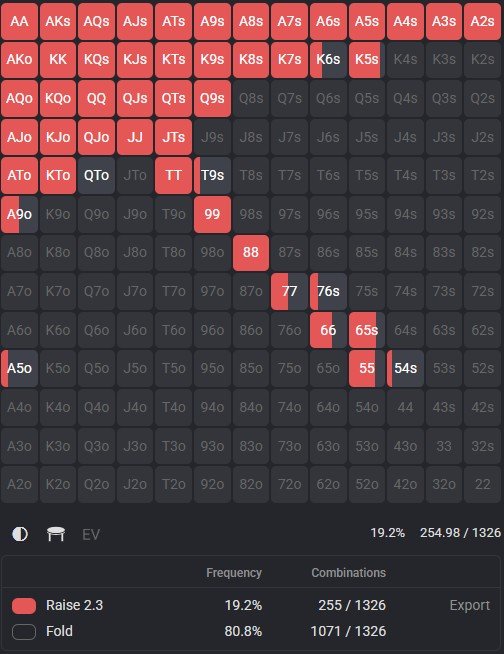
87s, 76s — typically in range from BTN at 100bb in most GTO solutions. On HJ/CO — borderline.
65s, 54s — borderline from CO (depends on stack and rake), usually in range from BTN.
43s, 32s — borderline even on BTN, from CO only if blinds are very weak, and not played from earlier positions. These hands suffer from high reverse implied odds, so many modern solvers recommend folding them even on the BTN.
Small pairs (22–55)
Their value comes almost entirely from set mining. The chance to flop a set is about 12%, so you need enough stack depth to make up for the times you miss.
55–66 — in range from MP and later in most 100bb solutions.
22–44 — borderline from MP/HJ, in range from CO and BTN at 70bb+. At 40bb and below — often removed or shifted into push/fold ranges.
How to add marginal hands gradually
The “one step at a time” principle
A common mistake is adding marginal hands immediately after studying ranges once. The correct approach is gradual, with validation at each step.
Step 1. Make sure you’re comfortable with your current range. If you’re still making mistakes with hands already included, it’s not time to expand.
Step 2. Pick one specific hand for one specific position: “I’ll start opening KTo from CO.” Just one adjustment.
Step 3. Play with this adjustment for 2–4 weeks. Pay attention to how comfortable postflop situations feel. Do you feel confident in tough spots?
Step 4. If everything feels good — add the next hand. If not, work on postflop play with this hand before moving on.
Adding priorities
Start with hands that are easiest to implement and provide the biggest EV gain:
- KTo from CO — strong hand, relatively simple postflop
- A4s–A5s from UTG — clear structure and positive EV in most cases
- 87s, 76s from HJ — if you’re confident playing connectors postflop
- QTo from CO — next step after mastering KTo
- Small pairs 22–44 from HJ — only at 80bb+ and preferably with weak players in the blinds
When to remove marginal hands
Adding hands isn’t irreversible. Reassess marginal hands when conditions change:
- You move to a limit with a different rake structure
- You switch formats (e.g., from 6-max to 9-max)
- Tables become noticeably more aggressive
- You consistently lose postflop with a specific marginal hand
FreeBetRange: how to see and train range edges
Visualizing range edges
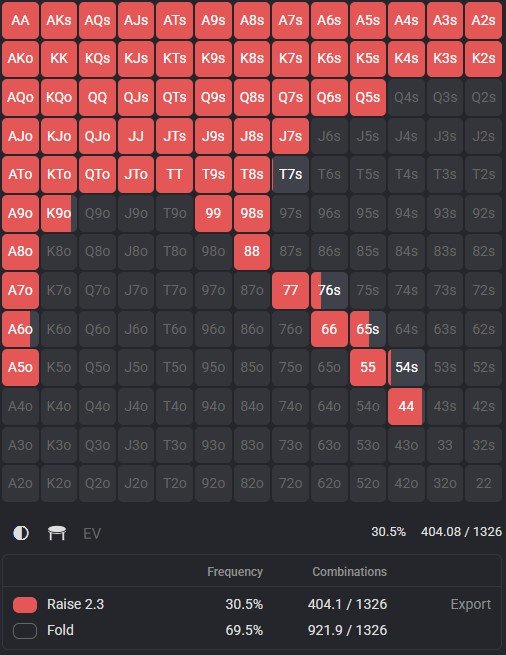
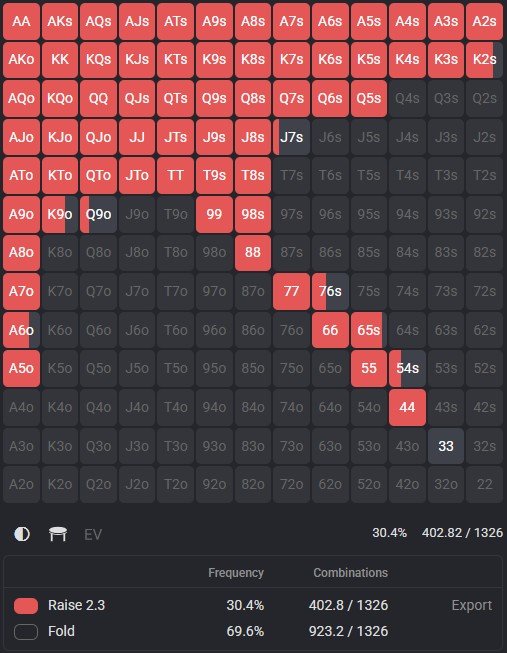
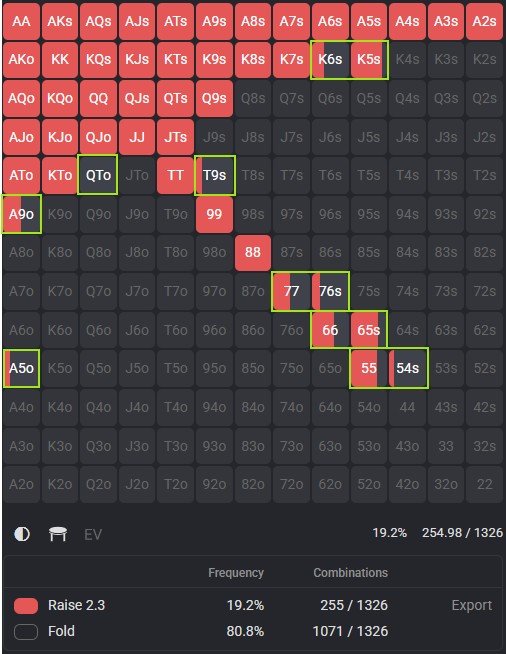
In FreeBetRange Range Viewer, the 13×13 matrix color coding clearly shows where the boundary lies:
- Fully filled cells — hands always opened (100%)
- Partially filled cells — marginal hands (mixed frequency)
- Empty cells — out of range
Partially filled cells are your exact list of marginal hands to study. Open a range from HJ and you’ll immediately see what sits on the edge — no need to memorize charts.
Building a personalized range with marginal hands
In the FreeBetRange Editor, you can:
- Load a base GTO range from the library for your position and format
- Add specific marginal hands you’ve decided to include
- Remove those you want to exclude (e.g., in aggressive reg-heavy games)
- Save versions like: “HJ vs passive pool”, “CO vs regs NL100”
This way, you can maintain multiple versions of your ranges for different conditions without keeping everything in your head.
Training marginal hands
Marginal hands are where training brings the most value — because they’re the ones that cause hesitation and doubt at the table.
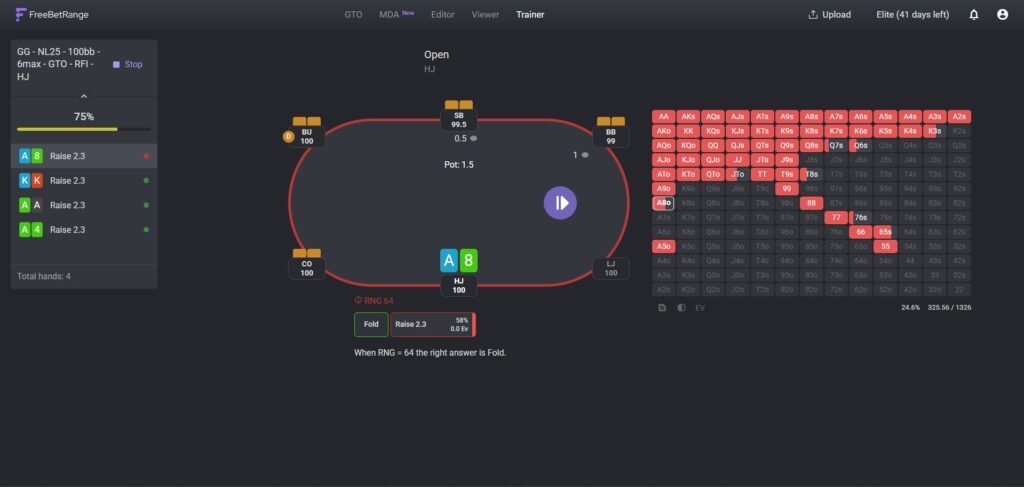
A practical tip: create a range that includes marginal hands and run it in the Trainer. Every time you’re dealt a marginal hand, make the decision quickly without overthinking. The goal is automation: after 50–100 repetitions, “should I open KTo from CO?” disappears as a question.
An additional feature: if you’re working with a coach or study group, FreeBetRange’s sharing function lets you share your ranges in one click — your coach can see which marginal hands you’ve included and give targeted feedback.
Summary: key takeaways
Marginal hands are not a flaw in your range or something to avoid. They’re a natural part of a dynamic strategy that requires a thoughtful approach.
Three factors drive most decisions: position (later = wider ranges), stack depth (speculative hands perform best at 80bb+), and player pool (weak players increase EV, aggressive regs reduce it).
Consistency beats precision. It’s better to have a clear rule like “always open QTo from CO” and stick to it than to rethink it every time.
Add gradually. One hand, one position, a few weeks of practice — then move on.
FreeBetRange supports you at every step: the Viewer shows range edges visually, the Editor helps customize your ranges, and the Trainer builds automatic decision-making.

Master GTO preflop strategy, build your own ranges, and train smarter — all in one powerful tool.
Try FreeBetRange