Comparing Real Player Ranges with GTO Data
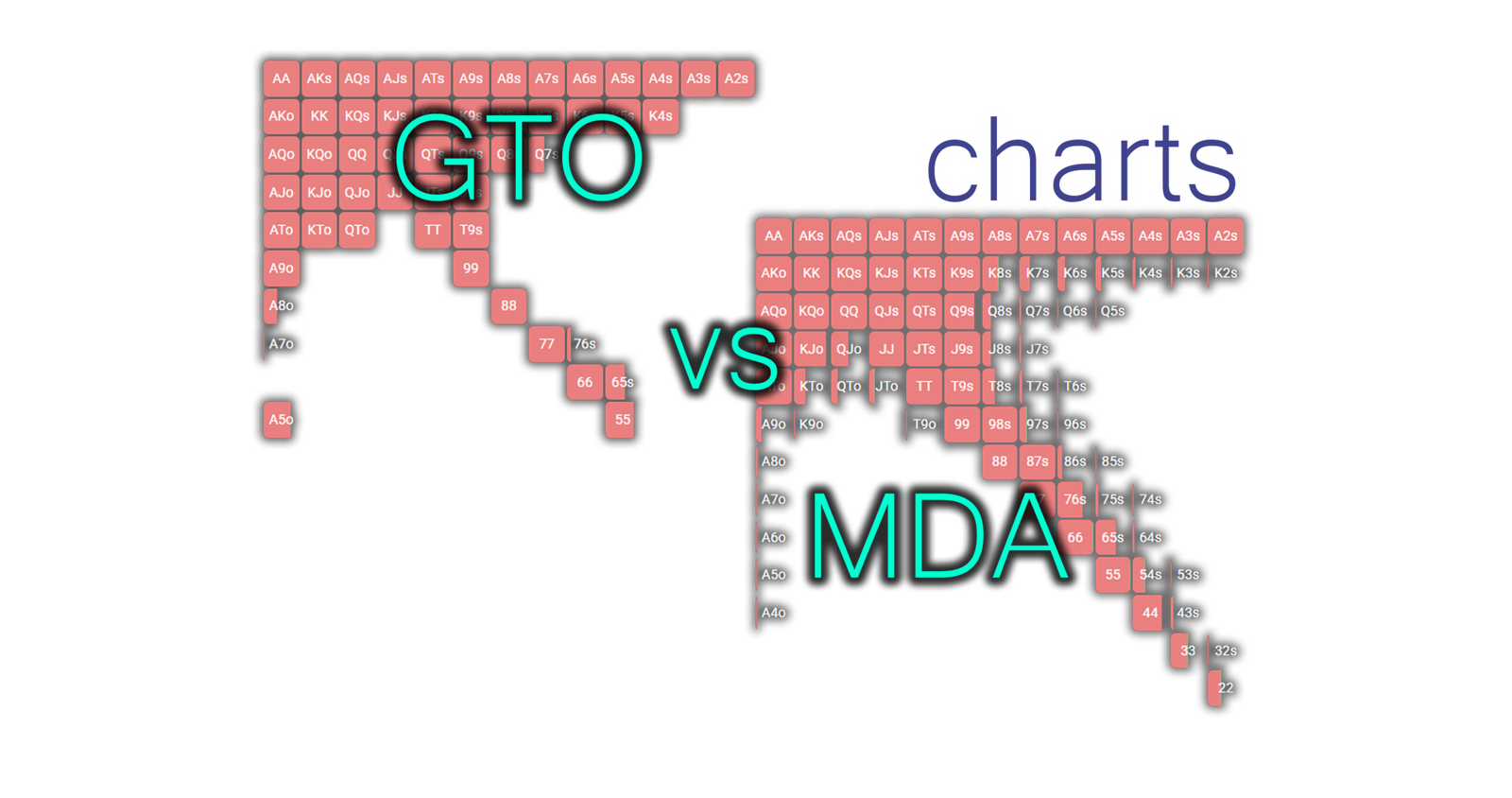
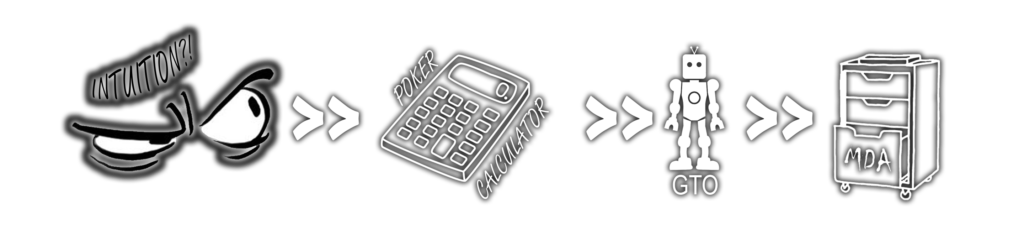
In the early days of poker, many players relied on intuition. Then the first poker calculators appeared, along with attempts to approach the game from a mathematical perspective—this gave rise to a completely different style of play. Later, with the development of computers and the internet, John Nash’s mathematical theory was applied to poker, leading to the creation of the GTO (Game Theory Optimal) framework—a theoretically optimal strategy. The next turning point came alongside the evolution of poker software and large-scale data analysis, introducing a new approach: MDA (Mass Data Analysis). This approach involves studying player statistics across massive hand databases to identify common weaknesses and exploit them for profit.
As poker evolved, so did the starting hand ranges that players bring into the game. In the early days of Hold’em, professionals could open from early position with nearly 50% of all starting hands. Today, the picture is completely different—typically no more than 19%.
At the same time, when it comes specifically to preflop strategy, the GTO approach is currently the most mathematically sound way to play.
Using the specialized platform FreeBetRange, which allows you to study different preflop strategies, create your own ranges, and reinforce your knowledge in the trainer, we will compare how real gameplay (MDA) deviates from the theoretically optimal model (GTO).
Choosing a preflop action for analysis
The most common action among professionals at the table is the open raise. At the beginning of your poker journey, open-raise ranges should be practiced in a trainer or studied through range charts.
At the same time, it’s equally important to understand the starting ranges your opponents are playing. Most postflop analysis and combinatorics will be based on these ranges.
In this article, we will focus specifically on open-raise ranges for our analysis.
Analysis criteria and setting parameters in FreeBetRange
This article examines hand ranges of real poker players, as well as GTO ranges for No-Limit Hold’em. The games are played at tables with three to six players. The rake is standard—similar to PokerStars, 888poker, and comparable rooms. No ante is used.
How to find the necessary parameters and ranges on the FreeBetRange website:
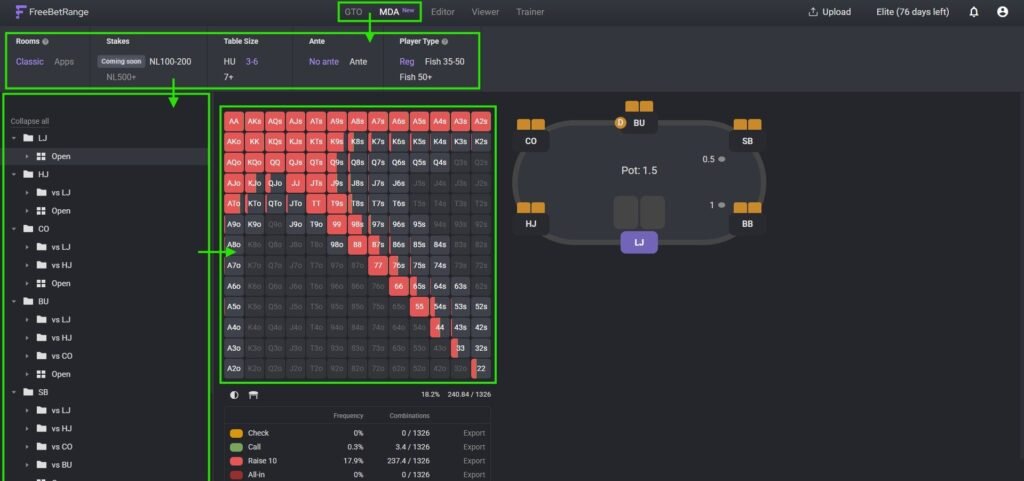
- Select MDA or GTO in the top panel.
- Set the parameters (rooms, game type, tables, limits), and exclude ante.
- Choose the action.
- Study the range displayed in the chart on the right.
FreeBetRange allows you to divide MDA data into three groups: regulars, fish with VPIP 35–50, and fish with VPIP 50+. Pay attention to this distinction.
* VPIP is a statistic that shows how often a player voluntarily puts money into the pot preflop, expressed as a percentage. The mathematical formula for VPIP is:
Number of situations where a player raised or called preflop / Number of situations where a player could have raised or called preflop * 100
We will compare each player type to GTO separately.
For the analysis, GTO data will use similar parameters to MDA based on overlapping characteristics:

Comparing regulars’ open-raise ranges with GTO ranges
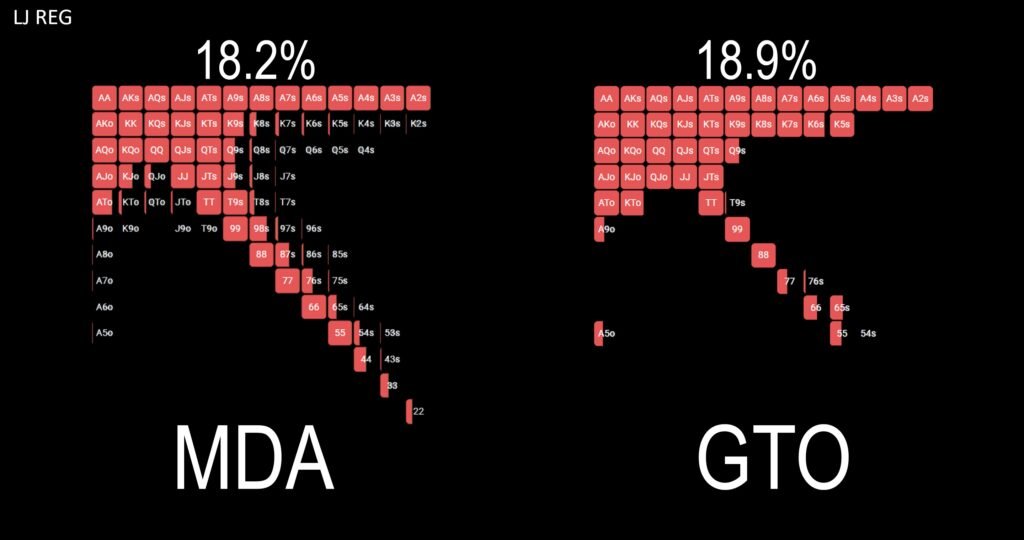
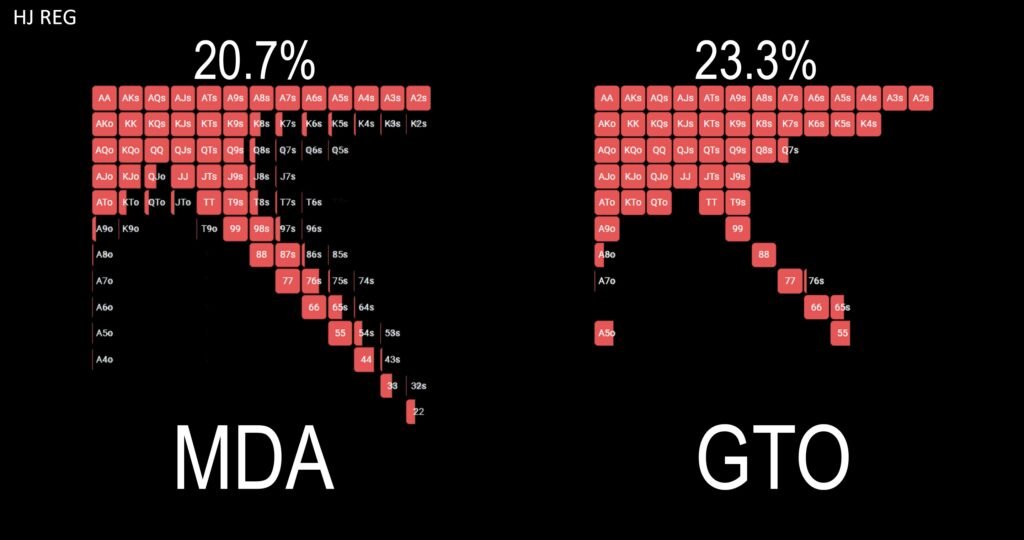
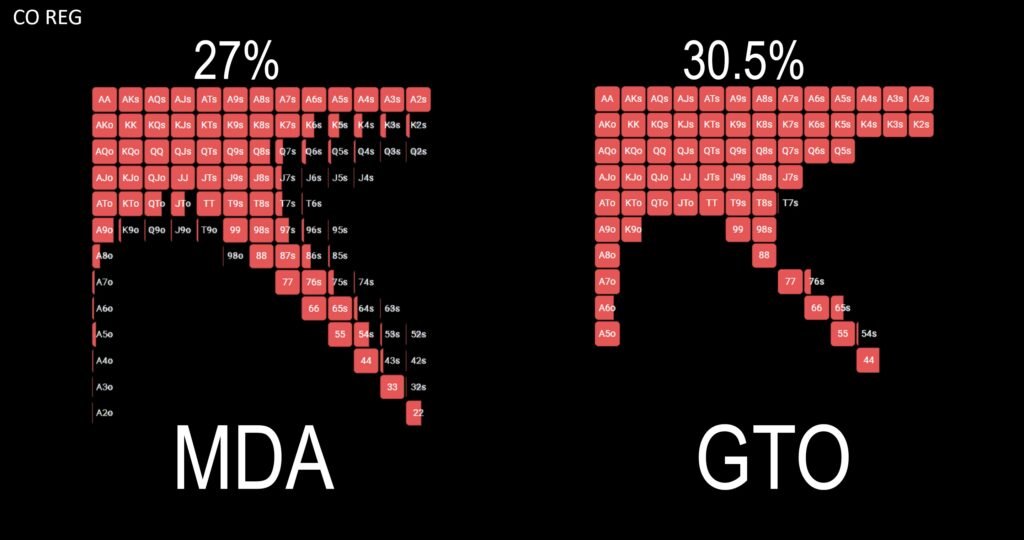
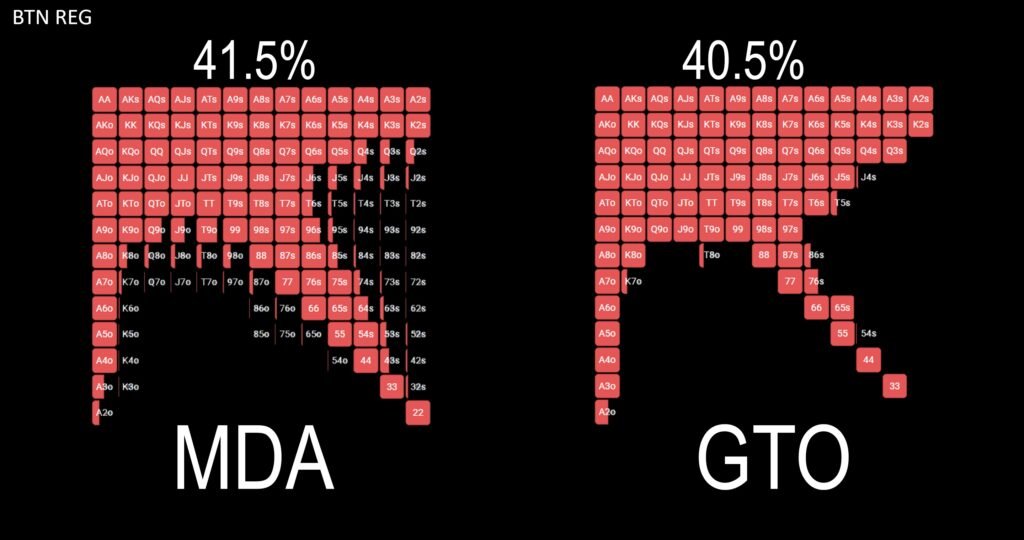
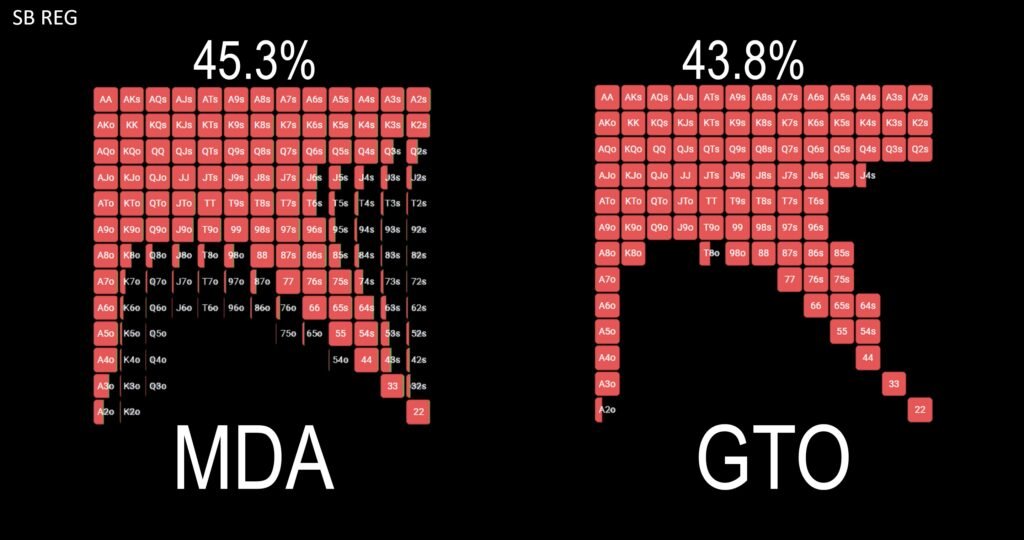
The screenshots show that regulars deviate only slightly from GTO. The difference does not exceed 3% across positions. From earlier positions, regulars rarely play suited Ax, Kx, Qx, Jx, and Tx hands. Instead, they prefer connectors, gappers, and small pocket pairs. Play from the small blind is almost identical to GTO.
These deviations are not critical. Most of them come down to players preferring connectors or small pocket pairs over Ax, Kx, Qx, Jx, and Tx hands. This creates an interesting dynamic—when playing using GTO ranges and hitting top pair on a draw-heavy board, you should be very cautious: your opponents often have strong equity. Preflop, however, it is generally sufficient to stick to balanced GTO decisions.
Fish (VPIP 35–50) ranges vs GTO ranges
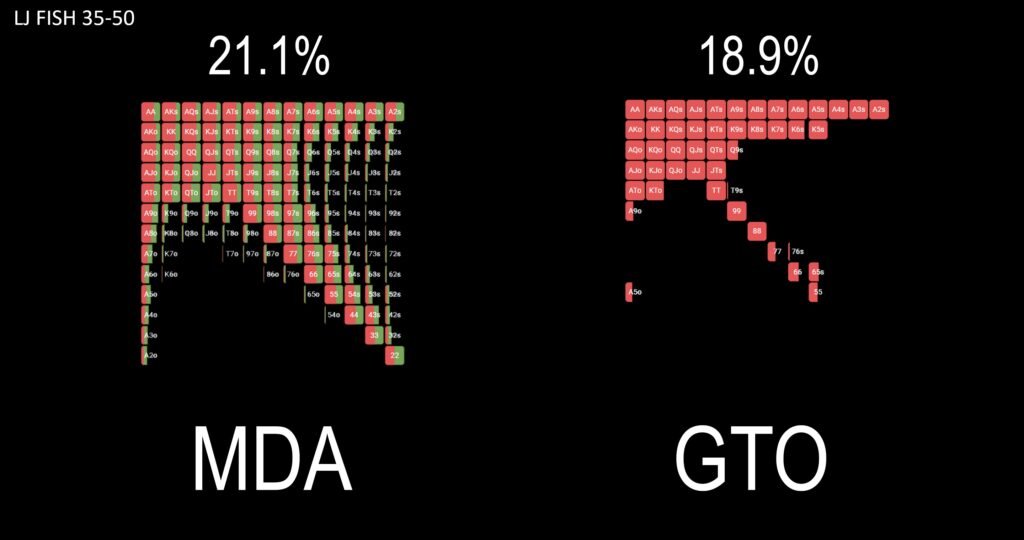
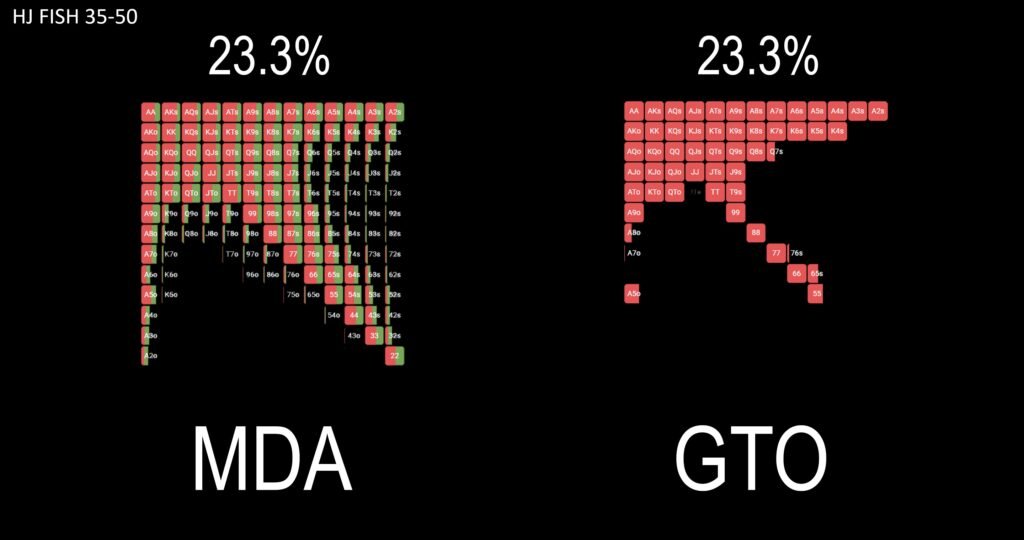
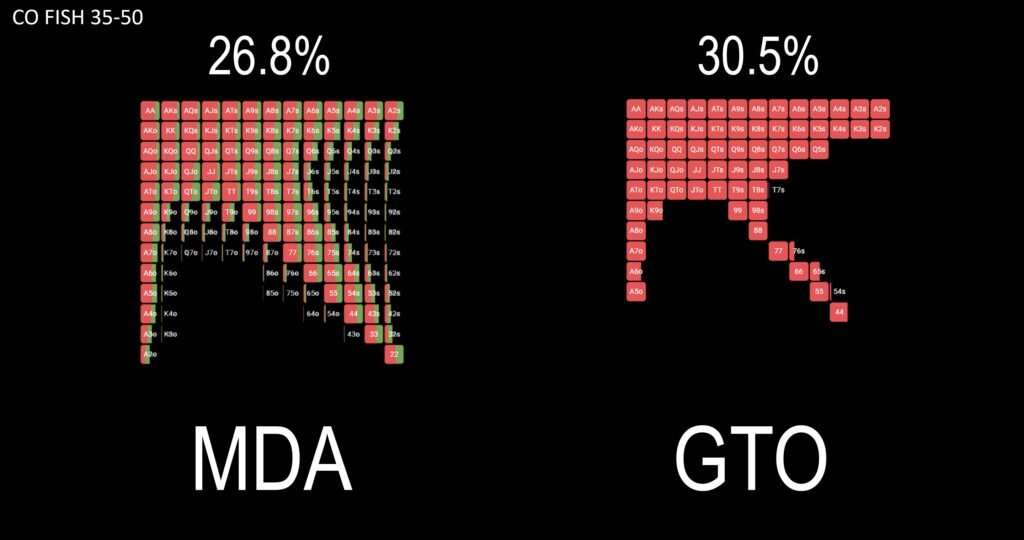
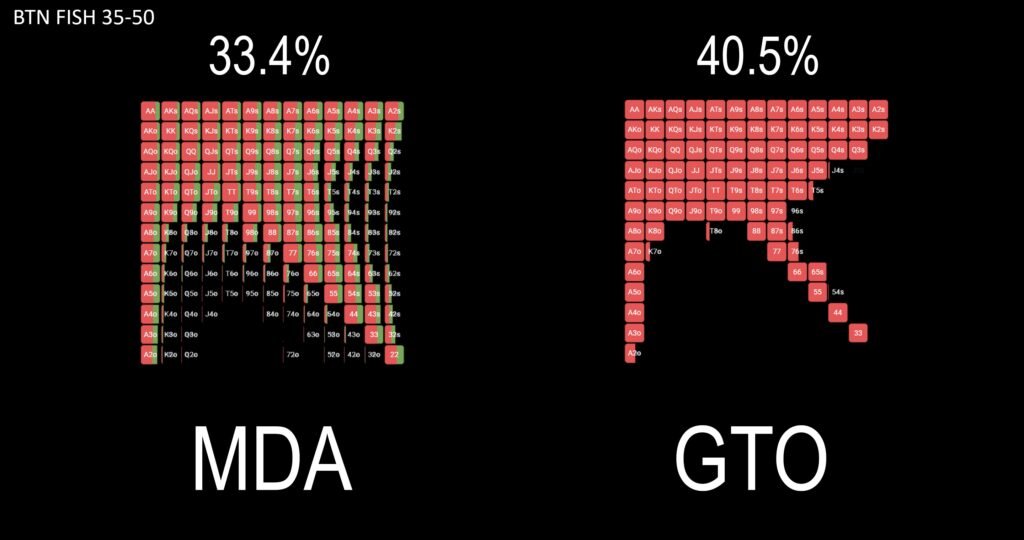
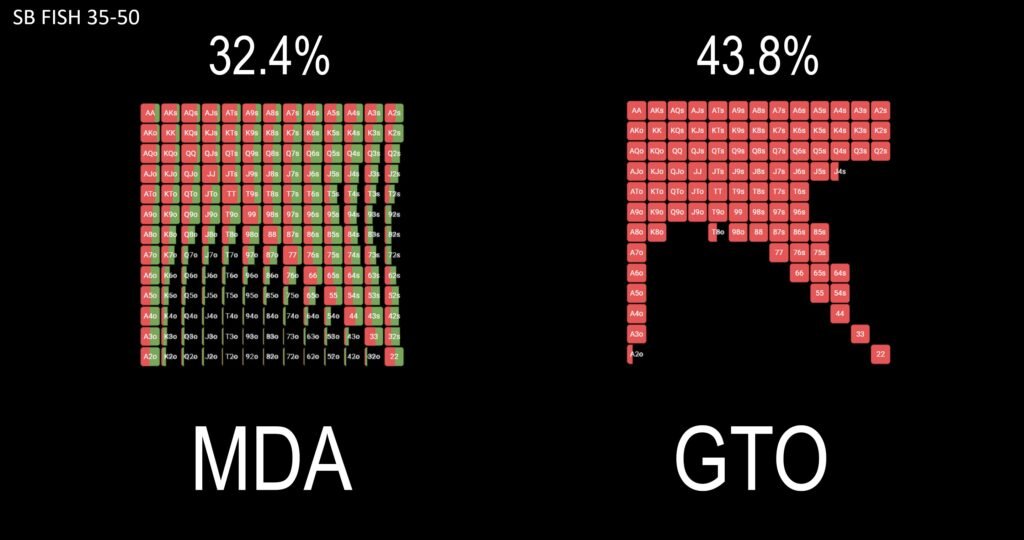
The difference in opening frequencies between fish with VPIP 35–50 and GTO is most noticeable in late positions, where their open-raise frequency drops by nearly 10%. Their hand selection is heavily skewed—they try to include almost every type of hand, from gappers and connectors to suited and offsuit Broadway hands (cards including A, K, Q, J, T).
Against such players, you can deviate from GTO preflop ranges and play wider. They are consistently unbalanced. At the same time, it’s important to account for each player’s postflop tendencies and adjust accordingly in every situation.
Fish (VPIP 50+) open-raise ranges vs GTO
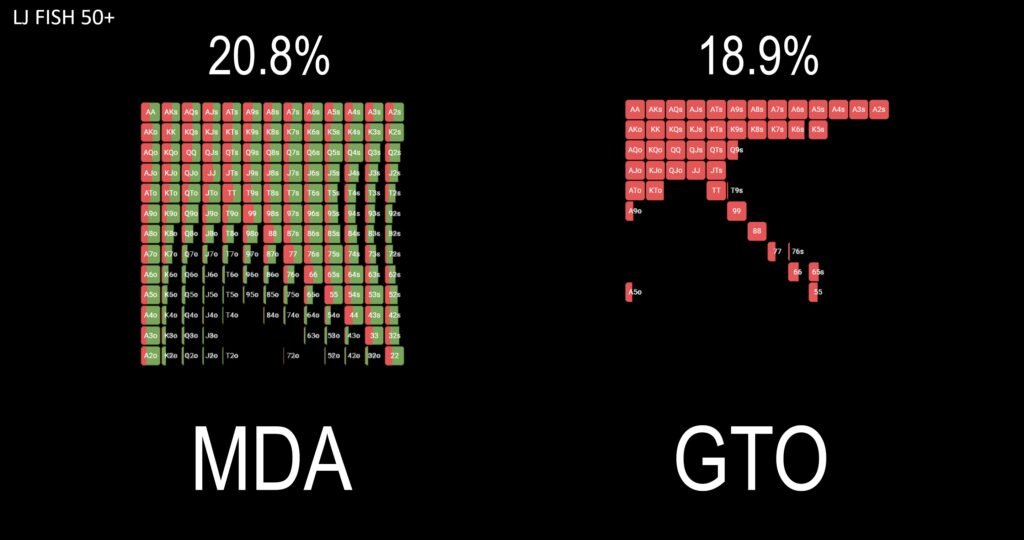
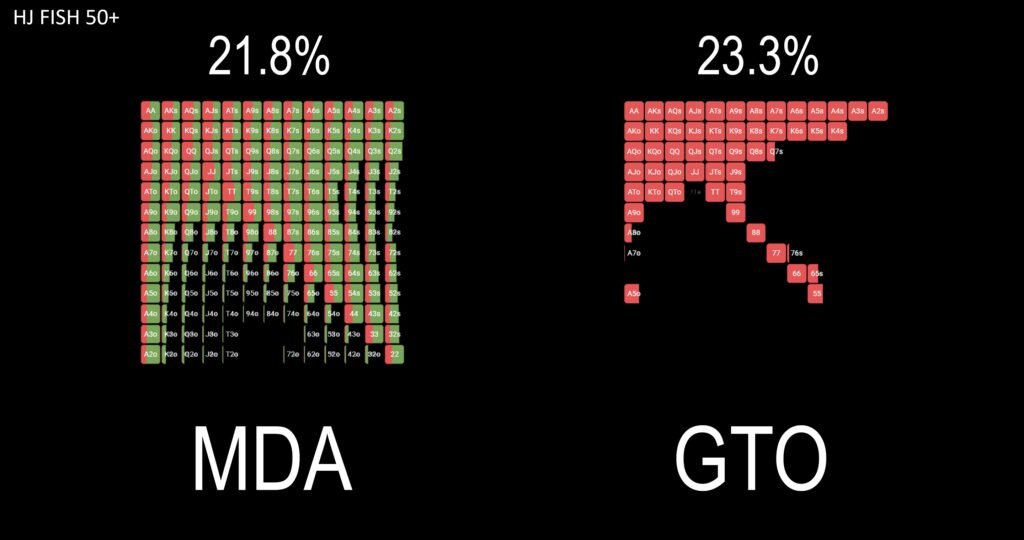
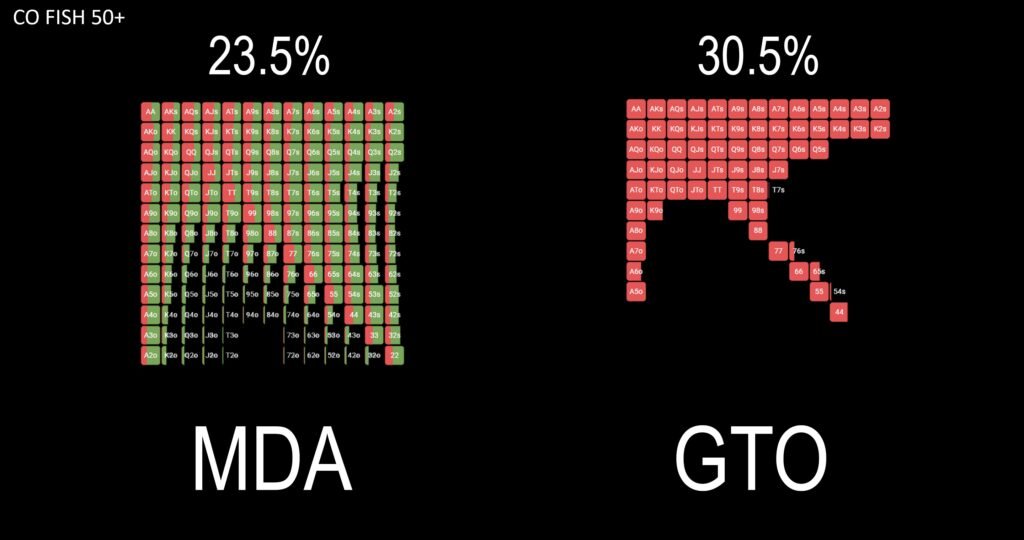
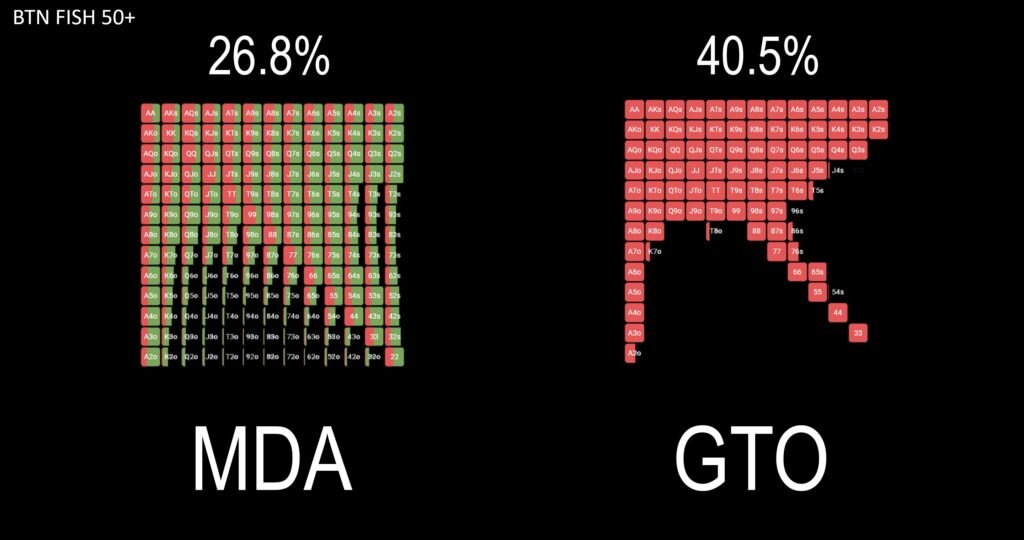
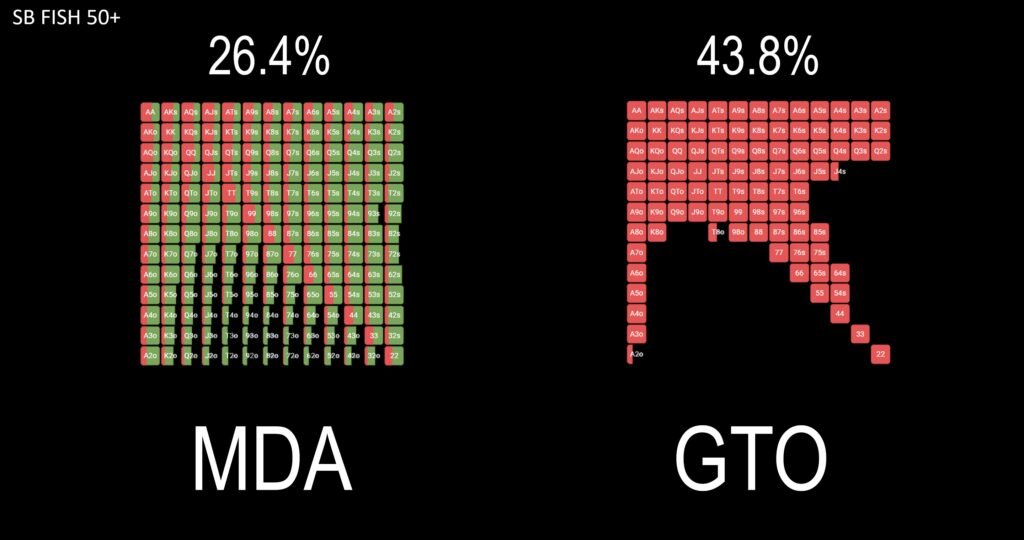
For fish with VPIP above 50%, open-raise ranges differ even more from GTO, especially in late positions where frequencies drop significantly. Their hand selection looks more like improvisation than structured play—essentially, almost any random combination of cards can be in play.
Using strict GTO ranges against such players is not optimal. As with VPIP 35–50 fish, you can—and should—expand your own ranges. Postflop, these opponents will often continue with very weak holdings, giving you excellent opportunities to realize your equity.
Conclusion
This analysis clearly shows how much real player behavior can differ from the theoretically optimal GTO model. While GTO remains the mathematical “gold standard” of preflop strategy, in practice we observe a wide spectrum of deviations—from minor ones among regulars to fundamental leaks among recreational players.
The key takeaway is simple: GTO knowledge gives you a benchmark, while understanding MDA deviations is what drives profit. Against regulars, you need a precise strategy with minimal exploitation. Against VPIP 35–50 fish, play aggressively and adjust your ranges accordingly. Against VPIP 50+ fish, you can often wait for strong hands and capitalize when they overplay weak pairs or any ace regardless of kicker.
Tools like FreeBetRange not only help you see these differences but also allow you to train your strategy with a focus on real player pools. Remember: GTO is your compass, and MDA is the map. Without the former, you’ll get lost in theory; without the latter, you’ll lose in practice.

Master GTO preflop strategy, build your own ranges, and train smarter — all in one powerful tool.
Try FreeBetRange